Serious erosion has occurred along the Pantai Kundur (Pantai Puteri) beaches at Klebang. If nothing or remedial works are carried out immediately, a portion of the road facing the beach front will collapse into the sea. This observation and fears have been highlighted by kampung folks who live at Pantai Kundur.
Authorities must act immediately to prevent this from happening. With the land reclaimation works at Klebang, there is no beautiful beach other than Pantai Kundur. With casuarina trees grown on the beaches, they give ample shade to visitors to relax and enjoy the sea breezes especially in the evenings.
If I correctly recall, Pantai Kundur beach was beset with erosion in late 1980s and beach rehabilitation works were done to rectify the erosion. Now, after 20 years, this problem has surfaced again.
Can this be due to the reclaimation works at Klebang Besar which is being undertaken now? By changing the coastline by reclaiming land from the sea, it will definitely change the wave patterns, strength and velocity of the waves. Maybe, we are seeing the results now at Pantai Kundur.
Here is a news report published recently:-
October 14, 2008 14:06 PM
Pantai Puteri Faces Coastal Erosion
MELAKA, Oct 14 (Bernama)
Pantai Puteri in Tanjung Keling, near here, is facing serious coastal erosion which could destroy the beauty of the beach.The effects of the erosion along the approximately four-kilometre stretch of beach could be seen where many of the casuarina trees had been uprooted while many more are in danger of being uprooted.
A check by Bernama reveals that in some places, only a few metres separate the road from the sea.The residents claimed that about 50 metres of the beach had been eroded within the last 10 years, bringing down the casuarina trees which had been planted to provide shade to visitors to the beach.
A resident, Abdullah Yahya, said the coastal erosion had resulted in a large chunk of the beach being 'swallowed' by the Straits of Melaka.
"The erosion becomes more serious especially during the season of the westerly winds as well as the possibility of the effects from the ongoing reclamation works at Pantai Klebang," he told Bernama, here today.
Abdullah, who is also chairman of the Melaka Fishermen's Association, said the erosion also seemed to threaten several structures built at the beach.He feared that the coastal erosion could also destroy the road beside the beach if nothing was done to check the erosion.
Meanwhile, the Chairman of the State Committee on Tourism, Culture and Heritage, Datuk Seet Har Cheow said the Melaka government had asked the Drainage and Irrigation Department (DID) to take action to resolve the eroson problem along the beach.
He said Pantai Puteri, located 11 kilometres from the Melaka city centre, was a tourist destination and the DID should act immediately to save the beach.-- BERNAMA
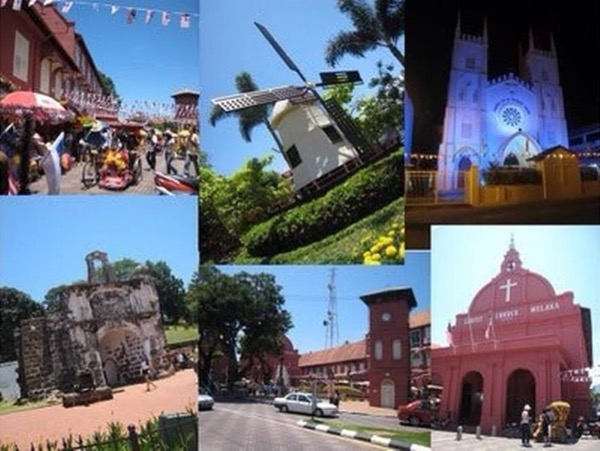
MELAKA - UNESCO World Heritage City since 2008. GPS: 2°11'58"N 102°15'02"E
Tuesday, October 14, 2008

Tuesday, September 23, 2008
PICTORIAL EXHIBITION ON TUNKU
24th. September 2008
There will be an important photograph exhibition on Malaysia's founding father - Tunku Abdul Rahman in October 2008. Restored photos unseen will be exhibited for all Malaysians to view for free. As Malaysians, these photos are part of our Malaysian Heritage.
24th. September 2008 “TERIMA KASIH TUNKU!” PICTORIAL EXHIBITION OF TUNKU
 |
| From MALACCA HIGH & MAHSOPA PHOTOS |
Come October 2008, be sure to view a fascinating exhibition on Malaysia’s first Prime Minister, Al Marhum Tunku Abdul Rahman Putra Al-Haj at Gallery 2, Department of Museums Malaysia, Kuala Lumpur.
YB Datuk Seri Hj. Mohd Shafie bin Hj Apdal, Minister of Unity, Culture, Arts and Heritage will officiate the opening on Tuesday, 7 October 2008 at 4.00pm.
This exhibition is organized by the Department of Museums Malaysia in collaboration with Canvas Art Sdn Bhd. On display are 222 pictures of the Tunku, including many from private collections. These rare pictures cover the period when he was a young schoolboy to a retired but active former Prime Minister.
A team of experts in Canvas Art painstakingly restored all the images. They took more than eight years to source the old photographs from private individuals and government institutions. Some have never been viewed in public before. The images have been carefully restored and reproduced on artist canvas or fine art paper of international archive standard and quality, with captions in Bahasa Malaysia and English.
The Tunku was like a father to all Malaysians. He knew our hearts and minds. Although his struggle to gain independence was not without sacrifice, he was able to free his beloved country from the yoke of colonialism without shedding a single drop of blood. This is the freedom we now cherish.
This pictorial presentation offers a glimpse of the Tunku’s long and historic journey along the path to Merdeka and beyond. It is important for the younger generation to appreciate the nation’s struggle for independence and the critical role played by great leaders who strived tirelessly to unite our multiracial society. It is only through harmony among the races that we can form a truly united and prosperous Malaysian nation.
In 1957, the Tunku said “Our great aim must be to make Malaya a haven of peace, harmony and happiness. We must strive for this with all our strength. We must be brave, we must be fair and we must be just, so that, come what may, we shall be ready as a united Malayan people to meet it.”
“ It is my daily prayer that all the different races in the country will continue to live together in friendship … Independence could never have been achieved without the unity of the various races” he said on his 80th birthday in 1983.
We hope Malaysians everywhere will have the opportunity to view this exclusive collection of photographs of the Tunku and his priceless legacy. Robert Lim Fung Wang Managing Director Canvas Art Sdn Bhd
NOTE - Reception is from 4pm to 6pm at Gallery 2 of the Department of Museums Malaysia, 7th October 2008. - Invitation list includes family and friends of Tunku, retired Ambassadors, Ambassadors of SEA countries and the United Kingdom.
Thursday, September 4, 2008
PERANAKAN CULTURE IN MELAKA

5th. September 2008
Do you know that the Peranakan ( Baba and Nyonya ) heritage and culture began in Melaka?
The culture of the Peranakans is a community which began when Chinese traders in the 17th century moved to Malacca. They settled down in Malacca and adopted local customs and traditions.
The community of Peranakans subsequently moved on to Penang in the late 18th century and to Singapore in the early 1900s. Though Melaka has a vibrant Peranakan heritage and has a private museum to highlight the Peranakan heritage, Singapore has opened two impressive museums that feature the Peranakan heritage.
In April, the Asian Civilisations Museum steered the opening of the $12-million Peranakan Museum in Armenian Street and today, the National University of Singapore opens its $4-million Baba House in Neil Road. Both the museum and the house are stocked with artefacts, both tell the story of the Peranakans.It is about time that the Baba and Nyonyas of Melaka pool their resources to preserve the uniqueness of the Peranakan culture.
It has been reported that the Melaka Peranakans will be hosting the "21st. Baba Convention" from 5th. to 7th. December 2008.
Peranakans from all over the world will converge into Melaka for this convention. It is expected Peranakans from Penang, Singapore, Phuket and overseas will meet up in Melaka for this historic event.
May we wish the organisers well for organising this event and wish them all the success in hosting this convention. As Melaka is now a World Heritage City, we need to preserve our unique cultures such as Malay, Chinese, Indian, Peranakan, Chitty, Portuguese and Dutch alive for generations to come.
Kamsiah.
NO BUS SERVICE FROM MELAKA TO KLIA

5th. September 2008
A traveller from Penang wrote to the newspapers complaining that there are no direct bus services from Melaka to Kuala Lumpur International Airport. We wonder why. There are buses travelling from Melaka Sentral to Kuala Lumpur but not one makes a detour to KLIA/LCCT at Sepang. This problem can be easily solved by having some bus services to call on KLIA/LCCT while enroute to Kuala Lumpur.
Also, some bus services while travelling from KL to Melaka can call on KLIA/LCCT as well.
We want to make Melaka, now a World Heritage City to be accessible to all visitors - locals and foreign travellers. A direct bus link will be good for the industry. We hope some bus companies will see this as a business opportunity not to be missed.
Below is the letter written to some national newspapers.
"While there are frequent services to Kuala Lumpur, other Klang Valley locations and Seremban, it appears to be quite inconvenient, especially for first-time visitors to Malaysia, to have to haul their entire luggage from bus to bus in order to reach Malacca.
This is exacerbated by the decentralisation of interstate bus services, most notably in Kuala Lumpur.
Further problems arise when one has to catch a flight from Malacca: having to change buses means that around twice the time of a direct journey, if not more, needs to be allocated in order not to miss one’s plane.
Interestingly, there are direct, albeit less frequent, bus services to Ipoh – a good 100km further away from KLIA compared to Malacca!
It would seem that only those who can afford a taxi or better can enjoy a direct ride to Malacca from the airport.
Given the promotion of Malacca as a premier tourist destination, it reflects poorly on this country that not enough seems to be done to facilitate the journey of both locals and foreigners to the recently-listed Unesco World Heritage Site.
The constant flow of tourists, not to mention locals, second-home owners and university students, should provide enough demand for a reasonably frequent direct bus service from Melaka Sentral to either KLIA, LCCT or both."
NEOH JOON KEE,
Penang.
A traveller from Penang wrote to the newspapers complaining that there are no direct bus services from Melaka to Kuala Lumpur International Airport. We wonder why. There are buses travelling from Melaka Sentral to Kuala Lumpur but not one makes a detour to KLIA/LCCT at Sepang. This problem can be easily solved by having some bus services to call on KLIA/LCCT while enroute to Kuala Lumpur.
Also, some bus services while travelling from KL to Melaka can call on KLIA/LCCT as well.
We want to make Melaka, now a World Heritage City to be accessible to all visitors - locals and foreign travellers. A direct bus link will be good for the industry. We hope some bus companies will see this as a business opportunity not to be missed.
Below is the letter written to some national newspapers.
"While there are frequent services to Kuala Lumpur, other Klang Valley locations and Seremban, it appears to be quite inconvenient, especially for first-time visitors to Malaysia, to have to haul their entire luggage from bus to bus in order to reach Malacca.
This is exacerbated by the decentralisation of interstate bus services, most notably in Kuala Lumpur.
Further problems arise when one has to catch a flight from Malacca: having to change buses means that around twice the time of a direct journey, if not more, needs to be allocated in order not to miss one’s plane.
Interestingly, there are direct, albeit less frequent, bus services to Ipoh – a good 100km further away from KLIA compared to Malacca!
It would seem that only those who can afford a taxi or better can enjoy a direct ride to Malacca from the airport.
Given the promotion of Malacca as a premier tourist destination, it reflects poorly on this country that not enough seems to be done to facilitate the journey of both locals and foreigners to the recently-listed Unesco World Heritage Site.
The constant flow of tourists, not to mention locals, second-home owners and university students, should provide enough demand for a reasonably frequent direct bus service from Melaka Sentral to either KLIA, LCCT or both."
NEOH JOON KEE,
Penang.
Friday, August 29, 2008
RM 50 Million Fund for Heritage Buildings in 2009 Budget
Yesterday, Prime Minister Badawi allocated RM 50 million fund for conservation work for the World Heritage Cities of Melaka and Georgetown in his Budget 2009. Compared to an overall budget of RM 209 billion, this amount is certainly a drop in an ocean.
Moreover, the amount is to be divided with Melaka and Georgetown. Conservation work and renovating heritage buildings are not cheap and involves specialised expertise. Hopefully, this allocation is just the beginning for Malaysia in recognising the importance of preserving our heritage for future generations.
I remember once some VIP mentioned that preserving old buildings is not progressive. They should be demolished and newer buildings must be built to replace them. How wrong these comments are. These old buildings with their unique characters reflect the architectural designs of their times and should be preserved.
Build newer buildings by all means BUT ensure that they are built outside the core heritage areas. Visitors to our heritage cities want to see unique buildings and cultures. They certainly do not want to see skyscrapers like theirs at home. If they want to see these skyscrapers,they can do so back in their own backyard.
Singapore has destroyed their heritage buildings during the building frenzy in 1970s and 1980s and they are regretting it. Bras Basah Road had elegant colonial buildings but they were bulldozed. Similarly, Hong Kong followed the same course on their buildings. Luckily, the Hong Kong authorities have maintained the Hong Kong Tram system.
The past can certainly co-exist with the present and we should preserve them for the future. Food for thought.
Moreover, the amount is to be divided with Melaka and Georgetown. Conservation work and renovating heritage buildings are not cheap and involves specialised expertise. Hopefully, this allocation is just the beginning for Malaysia in recognising the importance of preserving our heritage for future generations.
I remember once some VIP mentioned that preserving old buildings is not progressive. They should be demolished and newer buildings must be built to replace them. How wrong these comments are. These old buildings with their unique characters reflect the architectural designs of their times and should be preserved.
Build newer buildings by all means BUT ensure that they are built outside the core heritage areas. Visitors to our heritage cities want to see unique buildings and cultures. They certainly do not want to see skyscrapers like theirs at home. If they want to see these skyscrapers,they can do so back in their own backyard.
Singapore has destroyed their heritage buildings during the building frenzy in 1970s and 1980s and they are regretting it. Bras Basah Road had elegant colonial buildings but they were bulldozed. Similarly, Hong Kong followed the same course on their buildings. Luckily, the Hong Kong authorities have maintained the Hong Kong Tram system.
The past can certainly co-exist with the present and we should preserve them for the future. Food for thought.
Monday, August 25, 2008
GETTING THE CRUISE LINERS TO BERTH INTO MELAKA

25th. August 2008
It was recently reported that a Malaysian Cruise Liner had to by-pass Melaka because Melaka had no proper disembarking and embarking facilities. The waterway into Melaka is shallow and cruise liners must anchor off-shore before passengers and crew can disembark into Melaka.

A cruise liner can bring in at least 2000 passengers or more into our shores at any one time. Should half of the passengers and crew decide to visit Melaka, more than 1,000 people of high nett worth can visit for a single day. That means we need to have shuttle boats to bring in the visitors and to bring them back to the ship. Moreover, on reaching our shores, we need to transport them to our historical sites and entertainment venues. We need at least 25 air-conditioned buses to ferry them around.
Do we have the necessary facilities and space to cater for such a crowd at any one time?
The Melaka State authorities should identify a suitable space to build a proper CIQ facilities so that our special guests can visit us without any hassle. The spin off is inmeasurable since the large entourage per visit will give direct economic benefits to locals. Local traders can sell their local souvenirs, offer our visitors our local cuisines and show them our friendly hospitality.
Imagine how many guests can visit us if we can receive at least 4 cruise ships or more per month.
Tourism Melaka would like to appeal to our Melaka State Government to undertake this infrastructure as early as possible. We should undertake this project on a fastrack basis so that Melaka can reap the rewards from our status as Melaka - World Heritage City and Everlasting Living Heritage.
Tuesday, July 22, 2008
MELAKA MUST ENSURE SECURITY & SAFETY TO MALACCANS AND VISITORS TO MELAKA

During my recent weekend visit my home town in Melaka, I had a very bad experience in a recently opened cineplex . Located on the 5th. floor of the shopping complex, it housed 10 cinema screens for customers to view different movies.
The first thing you will notice on the ticketing level of this new cineplex is the lack of sitting. The whole area was not designed to house a cinema and is not catered for families to see shows at all.
There are no chairs for the elderly to sit and there is ONLY ONE lift and 2 excalators. There is also one fire exit.
There are no chairs for the elderly to sit and there is ONLY ONE lift and 2 excalators. There is also one fire exit.
My worst fears about the safety and security of the cineplex were justified when the show I attended ended just after mid-night on Saturday, 19th. July 2008.
Patrons who have gone to see their favourite shows at the different cineplexes were not allowed to use the 2 excalators to go down to the ground floor by the security guards. All patrons, young and elderly, were forced to use the fire exit staircase and a small lift catered for 10 persons only. With a minimum of 1000 or more patrons coming out of their cineplexes at about the same time, meant that the safety and security of patrons are being taken for granted. Patrons have to walk at least 5 floors of stairs to go to the groundfloor.
Patrons who have gone to see their favourite shows at the different cineplexes were not allowed to use the 2 excalators to go down to the ground floor by the security guards. All patrons, young and elderly, were forced to use the fire exit staircase and a small lift catered for 10 persons only. With a minimum of 1000 or more patrons coming out of their cineplexes at about the same time, meant that the safety and security of patrons are being taken for granted. Patrons have to walk at least 5 floors of stairs to go to the groundfloor.
What will happen if there is a fire on the fifth floor? With limited fire escapes and one small lift to cater for rushing patrons, we are just waiting for a disaster to occur. The questions raised here are :-
1. Has the Fire and Safety department done a safety check and who gave the approval for
1. Has the Fire and Safety department done a safety check and who gave the approval for
these cineplexes to be opened? Are there any fire springkler systems installed?
2. Since there is clearly a lack of fire escape exits, has the cineplex owners been notified of these
short comings?
short comings?
3. Who ordered the security guards to prevent patrons to use the escalators? In fact the
escalators should be changed to going down mode to ensure patrons leave the premises in an
orderly fashion instead of using fire exit only.
As Melaka City has just been given the status of Unesco World Heritage City together with Georgetown in Penang, the authorities in Melaka City must ensure the safety and security of Malaccans and guests to our heritage city.
We want visitors and locals alike to enjoy our city and feel safe while visiting our historical sites, enjoy the shopping and being entertained in various entertainment outlets such as cineplexes and theatres.
Tourism Melaka strongly urge the authorities to audit all the public entertainment centres around our City so that immediate measures can be taken before any unforseen incident occurs.
We want visitors and locals alike to enjoy our city and feel safe while visiting our historical sites, enjoy the shopping and being entertained in various entertainment outlets such as cineplexes and theatres.
Tourism Melaka strongly urge the authorities to audit all the public entertainment centres around our City so that immediate measures can be taken before any unforseen incident occurs.
Subscribe to:
Posts (Atom)