Ancient Malacca temple hopes to be marked on tourist map
Huge incense burner (left), placed at the spot since 1892, at the 200-year-old ancient San Duo Temple in Malacca. (Right) Stela to record every rebuild period of the temple.
Sin Chew Daily/Asia News Network
Friday, Mar 30, 2012
MALACCA - The Jalan Tokong Besi in Chinatown of Malacca is also known as Harmony Street, as worship places of three religions are located peacefully along the same street. Among them is 200-year-old ancient San Duo Temple.
The street also symbolises the harmonious coexistence of Buddhism, Taoism, Islamism and Hinduism in Malaysia.
The San Duo Temple is seldom mentioned due to the lack of propaganda. However, visitors always being impressed by the temple's rich historical heritage. Therefore, the Malacca Kwang Tung Huay Kuan entrusted to manage the temple hopes that the temple can be included in the Malacca tourist map.
The San Duo Temple has 217 years of history and was formally called the Qing Long Hui when it was built in 1795. It was later renamed as the San Duo Temple after the expansion was completed in 1857.
Many utensils in the temple, including incense burners and plaques, are originated from the Chinese Manchu Dynasty and being placed at the temple in 1891. The entrusted body also spent thousands of ringgit last year to repair relics in the temple.
(Left) "The 18th years of the Guangxu Empire" is clearly engraved on the beam. (Right) Ancient plaques hung on a wall of the temple's main hall shine after being repaired in recent years.
Malacca Kwang Tung Huay Kuan director Huang Da Wen said that the association hopes that the temple can be officially recognised as a tourist attraction to further promote the temple's characteristics and historical values.
He said that many tourists who passed by the Jalan Tokong Besi had been impressed by the ancient temple.
He also said that many century-old historical relics in the temple are priceless tourist attractions and if the government attaches importance to the temple and help to promote, it can help the association to strengthen maintenance and improve management of the temple's affairs.
He added that the maintenance of the temple relies on donations from worshipers and the association's assistence. Under a great financial pressure, the temple hold a chingay every two years.
(From left) The ancient bell originated from the 17th year of the Guangxu Empire is a precious historical treasure; historical utensils and a 155-year-old stele in the temple.
San Duo temple executive secretary Li Jin Long said that as the Jalan Tukang Besi has become more and more popular, the number of the temple's visitors have also increased. Therefore, if the government puts the temple on the tourist map, it is believed to attract more tourists.
He said that visitors are always surprised and impressed by the Chinese Manchu Dynasty utensils in the temple.
"No matter how expensive the cost is, we will still try to protect these historical items, including repairing plaques, columns and beams damaged by termites," he added.
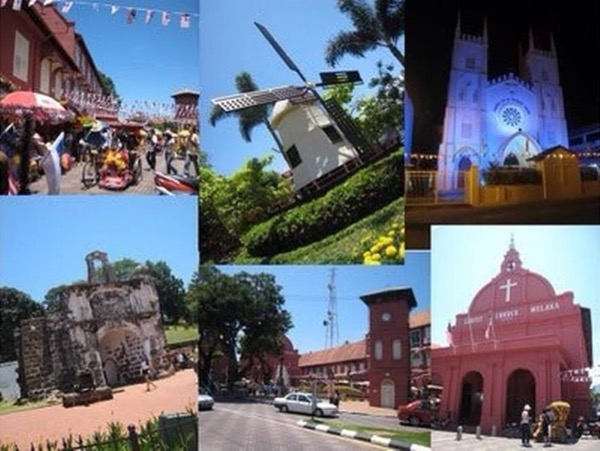
MELAKA - UNESCO World Heritage City since 2008. GPS: 2°11'58"N 102°15'02"E
Tuesday, April 3, 2012

AIRPORT HUB FOR BATU BERENDAM AIRPORT?
Tuesday April 3, 2012
Big plans for Batu Berendam Airport
MALACCA: The Malacca Government wants to transform the Batu Berendam Airport into a regional hub for the Asia-Pacific airlines.
Chief Minister Datuk Seri Mohd Ali Rustam said the plan to integrate international, domestic and regional services under one roof would attract more airlines.
“This vision has the potential to improve traffic flow with the upgrading of the airport into a regional hub with more aircraft gates,” he said here yesterday.
He said the plan is expected to gain momentum following the maiden flight of Sky Aviation for the Malacca-Tanjung Pinang-Malacca sector last Friday.
Mohd Ali said the Tanjung Pinang-Malacca-Tanjung Pinang sector is poised to attract an estimated 30,000 passengers annually.
The Star on March 24 reported that an airlines, a fusion between budget and high-end carrier, is eyeing Batu Berendam airport as their international hub.
Big plans for Batu Berendam Airport
MALACCA: The Malacca Government wants to transform the Batu Berendam Airport into a regional hub for the Asia-Pacific airlines.
Chief Minister Datuk Seri Mohd Ali Rustam said the plan to integrate international, domestic and regional services under one roof would attract more airlines.
“This vision has the potential to improve traffic flow with the upgrading of the airport into a regional hub with more aircraft gates,” he said here yesterday.
He said the plan is expected to gain momentum following the maiden flight of Sky Aviation for the Malacca-Tanjung Pinang-Malacca sector last Friday.
Mohd Ali said the Tanjung Pinang-Malacca-Tanjung Pinang sector is poised to attract an estimated 30,000 passengers annually.
The Star on March 24 reported that an airlines, a fusion between budget and high-end carrier, is eyeing Batu Berendam airport as their international hub.
Monday, April 2, 2012
TREATY OF LONDON 1824
In 1824, during the Napoleanic Wars in Europe, the Dutch reached a treaty with Great Britain under the "Treaty of London 1824"
The Dutch transferred to Great Britain the 'Town and Fort of Malacca and its Dependencies' in which Britain and the Netherlands in return took over Bencoolen in Sumatra which was controlled by Britain.
This move was done to prevent the French from getting Malacca should they defeat Holland in the then Napoleanic Wars.
It should be interesting to get a copy of this Treaty of London 1824 as a record of this important document.
The Dutch transferred to Great Britain the 'Town and Fort of Malacca and its Dependencies' in which Britain and the Netherlands in return took over Bencoolen in Sumatra which was controlled by Britain.
This move was done to prevent the French from getting Malacca should they defeat Holland in the then Napoleanic Wars.
It should be interesting to get a copy of this Treaty of London 1824 as a record of this important document.
SKY AVIATION FLIES TO MELAKA
Sky Aviation flies T. Pinang-Melaka route
The Jakarta Post | Mon, 04/02/2012 10:41 AM |
JAKARTA: Sky Aviation, a private Indonesian airline, has opened a new route connecting Tanjung Pinang in Riau Islands and Melaka in Malaysia, to meet the surge in passenger traffic between the two towns.
The first Sky Aviation’s international route is equipped with turboprop-powered airliners, Fokker F-50.
“With the new route opening, we hope the economic relations between the two regions can be improved,” said Sky Aviation senior safety advisory officer Chappy Hakim before the first flight in Raja Haji Fisabilillah airport, Tanjung Pinang, on Thursday.
Sky Aviation, one of Indonesia’s new private airlines, will operate a turboprop Fokker F-50 airplane to serve its first international route. At present, the airline serves 21 destinations in Indonesia, including Jakarta, Surabaya and Batam.
In the future, as Chappy stated, Sky Aviation will fly the route twice a week, every Wednesday and Sunday.
“Historically, Riau Islands and Melaka have a close relationship, and we are committed to maintaining it and taking it to the next level,” said the former Air Force chief Air Marshal, as quoted by Antara news agency.
The Jakarta Post | Mon, 04/02/2012 10:41 AM |
JAKARTA: Sky Aviation, a private Indonesian airline, has opened a new route connecting Tanjung Pinang in Riau Islands and Melaka in Malaysia, to meet the surge in passenger traffic between the two towns.
The first Sky Aviation’s international route is equipped with turboprop-powered airliners, Fokker F-50.
“With the new route opening, we hope the economic relations between the two regions can be improved,” said Sky Aviation senior safety advisory officer Chappy Hakim before the first flight in Raja Haji Fisabilillah airport, Tanjung Pinang, on Thursday.
Sky Aviation, one of Indonesia’s new private airlines, will operate a turboprop Fokker F-50 airplane to serve its first international route. At present, the airline serves 21 destinations in Indonesia, including Jakarta, Surabaya and Batam.
In the future, as Chappy stated, Sky Aviation will fly the route twice a week, every Wednesday and Sunday.
“Historically, Riau Islands and Melaka have a close relationship, and we are committed to maintaining it and taking it to the next level,” said the former Air Force chief Air Marshal, as quoted by Antara news agency.
Sunday, April 1, 2012
HISTORICAL SITES TO BE GAZETTED IN MELAKA
The National Heritage Department of Ministry of Information, Communication and Culture has published a public notice that Bandar Hilir Primary School, Jalan Parameswara, Melaka has been designated to be a heritage site on 29th March 2012.
Besides Bandar Hilir Primary School Building, the Meng Seng Charitable Hall at Jalan Taming Sari, was also to be gazetted. Meng Seng Charitable Hall was the place where Tunku Abdul Rahman raised impromptu funds for the delegation to travel to Great Britain to negotiate for Malayan Independence.
Any objections can be submitted to the ministry at info@warisan.gov.my.
There are a few buildings in Melaka which can also be gazetted for our future generations eg the Malacca High School Heritage Building.
Besides Bandar Hilir Primary School Building, the Meng Seng Charitable Hall at Jalan Taming Sari, was also to be gazetted. Meng Seng Charitable Hall was the place where Tunku Abdul Rahman raised impromptu funds for the delegation to travel to Great Britain to negotiate for Malayan Independence.
Any objections can be submitted to the ministry at info@warisan.gov.my.
There are a few buildings in Melaka which can also be gazetted for our future generations eg the Malacca High School Heritage Building.
Wednesday, March 28, 2012
MALACCA STRIVES ON HER HISTORY
Originally published Monday, March 26, 2012 at 9:09 AM
Malaysia's Malacca thrives with history
The hub of Malacca's civic colonial sites is Dutch Square — also called Red Square because of the color of its buildings.
By NAOMI LINDT The New York Times
On the tranquil grounds of the Cheng Hoon Teng Temple, Malaysia's oldest Taoist house of worship, late afternoon visitors bowed and offered burning wands of incense to a gilded statue of the Goddess of Mercy, the deity for whom the temple was founded in the 1600s. Tourists quietly watched or focused cameras on the structure's ornate, figurine-covered roof.
The placidity was interrupted by the muezzin's call from the nearby Kampung Kling Mosque, an amalgam of Corinthian columns, Portuguese tiles and Hindu carvings, built by Indian Muslims in 1748. And down the street at the 230-year-old Sri Poyyatha Vinayagar Moorthi Temple, the country's oldest Hindu temple, bare-chested and barefoot men in pastel-hued sarongs and garlands made of yellow blooms gathered to pray.
It was another seemingly sleepy afternoon in Malacca, Malaysia's oldest city, just two hours south of Kuala Lumpur and about four hours northwest of Singapore. But underneath that sleepiness, its foundation of vibrant multiculturalism, which dates back centuries, is very much alive and increasingly accessible, as it welcomes a handful of hotels and millions of international visitors a year.
"I just love Malacca — its laid-back, slow pace of life and the history in the buildings, the people, the culture," said a local resident, Colin Goh, 66, at Cheng Hoon, surrounded by a pair of red-and-gold sedan chairs and black-and-white photos that chronicled decades of the temple's religious festivals. "Everything you touch that is not new is old."
With his mix of Portuguese, Dutch, Chinese and "God only knows what else" heritage, Goh, a retired civil servant who now manages 8 Heeren Street, a restored 18th-century Dutch shophouse, embodies the city's colonial past. Founded around 1400 by a Malay-Hindu prince, Malacca, within a century, became Southeast Asia's most important trading port, luring an international cast of colonialists and merchants seeking a piece of the region's lucrative spice trade.
The hub of Malacca's civic colonial sites is Dutch Square — also called Red Square because of the color of its buildings — where tourists pose in front of the century-old Queen Victoria Fountain and trishaws festooned with plastic flowers gather. Nearby are the ruins of the A'Famosa fort, one of Asia's oldest European-built structures, erected by the Portuguese 500 years ago, and the imposing Stadthuys, or town hall, built by the Dutch in 1650 and later painted salmon red by the British, Malacca's last foreign rulers, whose reign lasted until 1957.
On the west side of the Malacca River, which flanks the square, along the old center's narrow, atmospheric streets, are hundreds of lantern-hung shophouses, some distinctly Chinese in style, others bearing geometric Art Deco trademarks, and grand residences with ornately tiled stoops built by wealthy families of the past. For centuries, these streets served as the town's commercial and residential center.
Malacca's eclectic charm, with some help from a UNESCO World Heritage designation in 2008 and its reputation as one of Malaysia's most exciting culinary destinations, has resulted in a steady growth in tourism. Last year 12 million visitors came, an increase of over 17 percent from 2010, according to a state tourism committee.
While some heritage buildings are still occupied by generations-old family businesses — silversmiths, watchmakers, dim sum purveyors — others have newer identities. At Temple Street, a shop run by a local artist, watercolors and hand-painted tiles depict idyllic street scenes. In another building, Nancy's Kitchen, a no-frills restaurant known for its local Nyonya cuisine, sells addictive delicacies like buttery pineapple tarts and onde-onde, glutinous rice balls filled with Malacca's famous palm sugar, known as gula Melaka, and covered in fresh coconut.
(BEGIN OPTIONAL TRIM.)
The Baba Nyonya Heritage Museum, in a grand, preserved residence on Heeren Street (officially known as Jalan Tun Tan Cheng Lock), pays tribute to Peranakans, a group of wealthy, sophisticated families that arose from the intermarrying of Babas, or Chinese traders, and Nyonyas, or local residents.
The Peranakans forged a distinct East-meets-West culture that represents much of what makes Malacca so fascinating: A racial and religious multiculturalism that's been cultivated and honored for centuries.This rich cultural heritage is also being celebrated in new lodging options. In 2009, a 100-year-old residential property down the street was converted into the 14-room Courtyard (AT) Heeren hotel, which blends era-appropriate furnishings with modern amenities. At the Snail House nearby, a charming French-Malaccan couple, Serge and K.C. Jardin, rent rooms in their carefully restored century-old home, with an open courtyard, a grand spiral staircase and high ceilings, offering travelers the chance to appreciate the nuances of Peranakan architecture.
"When you're inside, you feel as if you're in the presence of a wealthy Baba," Jardin said. "And though you're in the city center, it's so quiet you forget where you are."
Josephine Chua, a self-described "busybody housewife," history buff and proponent of Malacca's historic preservation, agreed.
"This place has been built on harmony since the 15th century," she said.
Chua, 55, traces her local roots back nine generations, to 1765, when one of her paternal ancestors migrated from Fujian, China.
"The religions have coexisted side by side for centuries — that's what makes us so unique and the town so great to live in," she said. This is a particularly telling statement in modern-day Malaysia, whose Muslim, Malay-majority government has been criticized for exploiting ethnic divisions for the sake of political gain. "We don't ask each other about one's race and religion, but what we do always ask each other is,'Have you eaten?"'
Where one has dined is not a question to be taken lightly in a city of restaurants serving home-cooked dishes, many of which have been passed down through generations. At Aunty Lee, a grandmotherly spot with lace curtains and pastel walls just a short drive from the historic center, septuagenarian chefs cook mouthwatering renditions of classic Nyonya dishes — chicken stewed with earthy, smoky keluak nuts; a fluffy omelet flavored with dried shrimp and chili; and cendol, a shaved ice dessert topped with coconut milk and gula Melaka.
Though authentic culture is easy to find in the city, residents like Chua and Goh worry about its future. The old center is now home to a recently opened Hard Rock Cafe, and many historic buildings have fallen into disrepair or been transformed into conventional souvenir shops and hostels, with no government financing to protect them.
Perhaps the most glaring example is Jonker Street, officially called Jalan Hang Jebat. Once known for its antiques shops, the strip now draws tour groups trawling stores stocked with Birkenstock knockoffs, batik linens and cheeky T-shirts with sayings like, "If YouTube MySpace, I'll Google Your Yahoo." It's particularly raucous on weekends, when a food and retail night market takes over.
Still, what captivated explorers and entrepreneurs centuries ago never seems far away, whether it's during a contemplative moment in a crumbling church or a stroll along the old town's back streets and its fragrant Chinese medicine shops. Or while you are sipping a steaming cup of tea during a downpour at Zheng He Tea House, a hidden spot two blocks from Jonker Street. "Once you step into Malacca, you can feel the positive energy," said Pak Siew Yong, the teahouse's friendly owner. "Foreigners, once they come here, they don't want to go home."
Malaysia's Malacca thrives with history
The hub of Malacca's civic colonial sites is Dutch Square — also called Red Square because of the color of its buildings.
By NAOMI LINDT The New York Times
On the tranquil grounds of the Cheng Hoon Teng Temple, Malaysia's oldest Taoist house of worship, late afternoon visitors bowed and offered burning wands of incense to a gilded statue of the Goddess of Mercy, the deity for whom the temple was founded in the 1600s. Tourists quietly watched or focused cameras on the structure's ornate, figurine-covered roof.
The placidity was interrupted by the muezzin's call from the nearby Kampung Kling Mosque, an amalgam of Corinthian columns, Portuguese tiles and Hindu carvings, built by Indian Muslims in 1748. And down the street at the 230-year-old Sri Poyyatha Vinayagar Moorthi Temple, the country's oldest Hindu temple, bare-chested and barefoot men in pastel-hued sarongs and garlands made of yellow blooms gathered to pray.
It was another seemingly sleepy afternoon in Malacca, Malaysia's oldest city, just two hours south of Kuala Lumpur and about four hours northwest of Singapore. But underneath that sleepiness, its foundation of vibrant multiculturalism, which dates back centuries, is very much alive and increasingly accessible, as it welcomes a handful of hotels and millions of international visitors a year.
"I just love Malacca — its laid-back, slow pace of life and the history in the buildings, the people, the culture," said a local resident, Colin Goh, 66, at Cheng Hoon, surrounded by a pair of red-and-gold sedan chairs and black-and-white photos that chronicled decades of the temple's religious festivals. "Everything you touch that is not new is old."
With his mix of Portuguese, Dutch, Chinese and "God only knows what else" heritage, Goh, a retired civil servant who now manages 8 Heeren Street, a restored 18th-century Dutch shophouse, embodies the city's colonial past. Founded around 1400 by a Malay-Hindu prince, Malacca, within a century, became Southeast Asia's most important trading port, luring an international cast of colonialists and merchants seeking a piece of the region's lucrative spice trade.
The hub of Malacca's civic colonial sites is Dutch Square — also called Red Square because of the color of its buildings — where tourists pose in front of the century-old Queen Victoria Fountain and trishaws festooned with plastic flowers gather. Nearby are the ruins of the A'Famosa fort, one of Asia's oldest European-built structures, erected by the Portuguese 500 years ago, and the imposing Stadthuys, or town hall, built by the Dutch in 1650 and later painted salmon red by the British, Malacca's last foreign rulers, whose reign lasted until 1957.
On the west side of the Malacca River, which flanks the square, along the old center's narrow, atmospheric streets, are hundreds of lantern-hung shophouses, some distinctly Chinese in style, others bearing geometric Art Deco trademarks, and grand residences with ornately tiled stoops built by wealthy families of the past. For centuries, these streets served as the town's commercial and residential center.
Malacca's eclectic charm, with some help from a UNESCO World Heritage designation in 2008 and its reputation as one of Malaysia's most exciting culinary destinations, has resulted in a steady growth in tourism. Last year 12 million visitors came, an increase of over 17 percent from 2010, according to a state tourism committee.
While some heritage buildings are still occupied by generations-old family businesses — silversmiths, watchmakers, dim sum purveyors — others have newer identities. At Temple Street, a shop run by a local artist, watercolors and hand-painted tiles depict idyllic street scenes. In another building, Nancy's Kitchen, a no-frills restaurant known for its local Nyonya cuisine, sells addictive delicacies like buttery pineapple tarts and onde-onde, glutinous rice balls filled with Malacca's famous palm sugar, known as gula Melaka, and covered in fresh coconut.
(BEGIN OPTIONAL TRIM.)
The Baba Nyonya Heritage Museum, in a grand, preserved residence on Heeren Street (officially known as Jalan Tun Tan Cheng Lock), pays tribute to Peranakans, a group of wealthy, sophisticated families that arose from the intermarrying of Babas, or Chinese traders, and Nyonyas, or local residents.
The Peranakans forged a distinct East-meets-West culture that represents much of what makes Malacca so fascinating: A racial and religious multiculturalism that's been cultivated and honored for centuries.This rich cultural heritage is also being celebrated in new lodging options. In 2009, a 100-year-old residential property down the street was converted into the 14-room Courtyard (AT) Heeren hotel, which blends era-appropriate furnishings with modern amenities. At the Snail House nearby, a charming French-Malaccan couple, Serge and K.C. Jardin, rent rooms in their carefully restored century-old home, with an open courtyard, a grand spiral staircase and high ceilings, offering travelers the chance to appreciate the nuances of Peranakan architecture.
"When you're inside, you feel as if you're in the presence of a wealthy Baba," Jardin said. "And though you're in the city center, it's so quiet you forget where you are."
Josephine Chua, a self-described "busybody housewife," history buff and proponent of Malacca's historic preservation, agreed.
"This place has been built on harmony since the 15th century," she said.
Chua, 55, traces her local roots back nine generations, to 1765, when one of her paternal ancestors migrated from Fujian, China.
"The religions have coexisted side by side for centuries — that's what makes us so unique and the town so great to live in," she said. This is a particularly telling statement in modern-day Malaysia, whose Muslim, Malay-majority government has been criticized for exploiting ethnic divisions for the sake of political gain. "We don't ask each other about one's race and religion, but what we do always ask each other is,'Have you eaten?"'
Where one has dined is not a question to be taken lightly in a city of restaurants serving home-cooked dishes, many of which have been passed down through generations. At Aunty Lee, a grandmotherly spot with lace curtains and pastel walls just a short drive from the historic center, septuagenarian chefs cook mouthwatering renditions of classic Nyonya dishes — chicken stewed with earthy, smoky keluak nuts; a fluffy omelet flavored with dried shrimp and chili; and cendol, a shaved ice dessert topped with coconut milk and gula Melaka.
Though authentic culture is easy to find in the city, residents like Chua and Goh worry about its future. The old center is now home to a recently opened Hard Rock Cafe, and many historic buildings have fallen into disrepair or been transformed into conventional souvenir shops and hostels, with no government financing to protect them.
Perhaps the most glaring example is Jonker Street, officially called Jalan Hang Jebat. Once known for its antiques shops, the strip now draws tour groups trawling stores stocked with Birkenstock knockoffs, batik linens and cheeky T-shirts with sayings like, "If YouTube MySpace, I'll Google Your Yahoo." It's particularly raucous on weekends, when a food and retail night market takes over.
Still, what captivated explorers and entrepreneurs centuries ago never seems far away, whether it's during a contemplative moment in a crumbling church or a stroll along the old town's back streets and its fragrant Chinese medicine shops. Or while you are sipping a steaming cup of tea during a downpour at Zheng He Tea House, a hidden spot two blocks from Jonker Street. "Once you step into Malacca, you can feel the positive energy," said Pak Siew Yong, the teahouse's friendly owner. "Foreigners, once they come here, they don't want to go home."
MELAKA AIR TO FLY TO PENANG FROM 6TH.APRIL 2012
Published: Wednesday March 28, 2012 MYT 5:39:00 PM
Melaka Air set for maiden flight to Penang on April 6
MALACCA: Melaka Air will start its maiden flight from the Malacca International Airport in Batu Berendam to Penang on April 6.
Melaka Air, operated by Melaka Holiday Sdn Bhd in cooperation with Firefly, will fly twice a week (Monday and Friday) to Penang using an aircraft with a capacity to fly 72 passengers.
Melaka Holiday Sdn Bhd chairman Syed Mahaza Syed Dakian the flight would take 1 hour 10 minutes and tourists coming to Malacca from Penang would be able to arrive in comfort to visit interesting places in the state.
"There is a demand for such service from Penang since tourists who arrive in Penang would also like to visit Malacca which is also a Unesco World Heritage site just like Penang," he told reporters after opening the Melaka Air and Melaka Holiday counters here Wednesday.
The introduction of the air route to and from Penang would shorten the travel time for tourists as well as save cost.
Melaka Air, which started its operations last November, was previously servicing only the Malacca-Medan (Indonesia) sector.
Syed Mahaza said Melaka Holiday also offered travel packages, especially five days four nights or four days three nights to selected destinations. - Bernama
Melaka Air set for maiden flight to Penang on April 6
MALACCA: Melaka Air will start its maiden flight from the Malacca International Airport in Batu Berendam to Penang on April 6.
Melaka Air, operated by Melaka Holiday Sdn Bhd in cooperation with Firefly, will fly twice a week (Monday and Friday) to Penang using an aircraft with a capacity to fly 72 passengers.
Melaka Holiday Sdn Bhd chairman Syed Mahaza Syed Dakian the flight would take 1 hour 10 minutes and tourists coming to Malacca from Penang would be able to arrive in comfort to visit interesting places in the state.
"There is a demand for such service from Penang since tourists who arrive in Penang would also like to visit Malacca which is also a Unesco World Heritage site just like Penang," he told reporters after opening the Melaka Air and Melaka Holiday counters here Wednesday.
The introduction of the air route to and from Penang would shorten the travel time for tourists as well as save cost.
Melaka Air, which started its operations last November, was previously servicing only the Malacca-Medan (Indonesia) sector.
Syed Mahaza said Melaka Holiday also offered travel packages, especially five days four nights or four days three nights to selected destinations. - Bernama
Subscribe to:
Posts (Atom)