Malacca pilgrimage
tabla!
Fri, May 13, 2011
By Surendar Kaur
DON'T be surprised if you don't see too many Sikhs in Singapore next weekend. Most of us will be in Malacca from May 20 to 22 for prayers at the Gurdwara Sahib Malacca.
The weekend of prayers draws thousands of Sikhs and others from Malaysia and Singapore to the Jalan Temenggong gurdwara. They go to pay their respects to the late Baba Sohan Singh who spread the Sikh religion with his inspiring discussions and speeches.
Ever since he died on May 24, 1972, after a short illness, the Gurdwara Sahib Malacca commemorates the date by holding an Akhand Path (continuous recitation of the Sikh sacred religious texts for approximately 21/2 days) and prayers annually. Popularly known as Baba Sohan Singh's Barsi, it is a time to pray for whatever help they seek and also express gratitude for the help received.
I, for one, have been making this annual pilgrimage to Malacca for the past 17 years. The first time, in 1994, I prayed to be blessed with a child. My daughter was born a year later - call it divine or medical intervention, but my husband and I were thrilled - and since then we make sure we are at Gurdwara Sahib Malacca every year.
Apart from the prayers, I also enjoy the social aspect of this pilgrimage. With so many Sikhs descending on Malacca for the weekend - thousands drive up from Singapore or charter buses for the trip while even more arrive from other Malaysian cities and towns - hotels are packed and room reservations have to be made very early.
In the temple, we attend the prayer sessions and do sewa (performing a service) which can include helping to prepare food and serving it to the devotees.
And this is where the weekend takes on a multiracial flavour: Not only does the temple serve free food to anyone who walks in and takes a seat in the dining area, many Chinese volunteers provide items like you tiao (fried crullers) and soya bean drinks while south Indians cook thosais or pratas for breakfast.
In addition, there is a blood donation drive, with medical teams in attendance, while a pasar malam (night market) always springs up outside the temple with stalls selling Punjabi outfits, CDs, Indian sweets and many other items.
While some people shop, others do some sightseeing. A common sight during the weekend is elderly women riding in a cycle rickshaw which has Hindi music blaring from its huge speakers. And once night falls, a bhangra night is also organised for the youngsters to have some fun.
For my family and me, this is a great outing where we combine our religious duties with some shopping and fun. In fact, it even becomes an opportunity to catch up with relatives and friends from the community. So, if you're in Malacca next weekend, come and say hello.
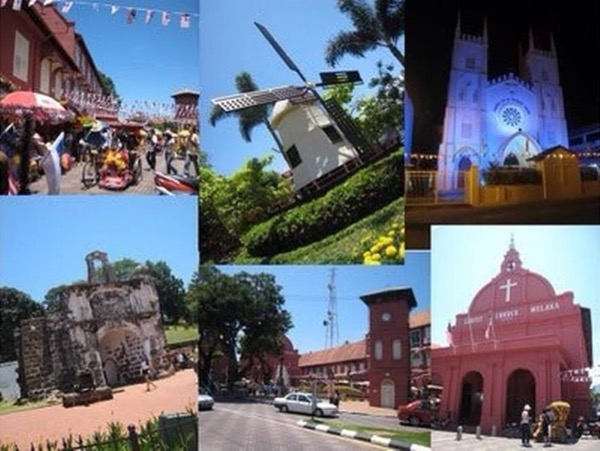
MELAKA - UNESCO World Heritage City since 2008. GPS: 2°11'58"N 102°15'02"E
Friday, May 13, 2011

Thursday, May 12, 2011
Billion ringgit offer to bring up treasures
2011/05/11
By Jason Gerald John
jasong@nst.com.my
Share |
MALACCA: The state government has again offered a billion ringgit deal to the private sector to salvage treasures from sunken ships lying in the sea off Malacca.
About 13 ships, comprising merchant ships and warships that sunk in the strait about 500 years ago, have been identified and its treasures are estimated to be worth billions of ringgit.
Among them are the Middleburg, which sank on Aug 16, 1606; Wieringen (June 2, 1636), Franeker (Jan 18, 1642), Bambeek (Jan 12, 1702), and Overduin (June 27, 1784).
They are located off Tanjung Tuan, Tanjung Kling, Tanjung Pinang, Pulau Undan and Permatang Rumput, respectively.
Chief Minister Datuk Seri Mohd Ali Rustam said investigations showed the vessels could have sank during Malacca's heyday as a trading port.
"We are interested in salvaging these sunken treasures which are believed to be worth billions of ringgit but we have no monetary resources as it takes some RM3 million to salvage treasures from one single vessel.
"This is why I am seeking the help of interested private shipwreck salvagers to help the state bring up the treasures and they will be rewarded for their efforts.
"Half the treasures which are salvaged must be handed over to the Federal Government while the remaining half could be shared equally by the state government and the private company undertaking the salvage works," he said.
He was speaking to reporters after the weekly state executive council meeting yesterday. In 2004, porcelain believed to be more than 200 years old was salvaged from a shipwreck about two nautical miles off the coast of Limbungan.
The artefacts, dating back to the 1800s, are believed to be shards of two vases from China and Vietnam, and were salvaged by Royal Malaysian Navy divers after being detected a sonar scan. The search and salvage operation is estimated to have cost the state government about RM171,000.
It was also reported that at least six Portuguese ships might have sunk along the Malacca coastline and these do not include 12 shipwrecks discovered off Tanjung Tuan by a local salvaging company, Serene Zone Sdn Bhd, and several others off Pulau Upeh.
Ali said he had been making a similar offer since 2000 to shipwreck salvage companies to help uncover the treasures from the depths of the Straits of Malacca but there were no takers. "If there are no takers after this, we might ask the Federal Government, through the Ministry of Tourism and Ministry of Culture, Art and Heritage, to help us salvage the treasures as these could also be national heritage items," he said.
2011/05/11
By Jason Gerald John
jasong@nst.com.my
Share |
MALACCA: The state government has again offered a billion ringgit deal to the private sector to salvage treasures from sunken ships lying in the sea off Malacca.
About 13 ships, comprising merchant ships and warships that sunk in the strait about 500 years ago, have been identified and its treasures are estimated to be worth billions of ringgit.
Among them are the Middleburg, which sank on Aug 16, 1606; Wieringen (June 2, 1636), Franeker (Jan 18, 1642), Bambeek (Jan 12, 1702), and Overduin (June 27, 1784).
They are located off Tanjung Tuan, Tanjung Kling, Tanjung Pinang, Pulau Undan and Permatang Rumput, respectively.
Chief Minister Datuk Seri Mohd Ali Rustam said investigations showed the vessels could have sank during Malacca's heyday as a trading port.
"We are interested in salvaging these sunken treasures which are believed to be worth billions of ringgit but we have no monetary resources as it takes some RM3 million to salvage treasures from one single vessel.
"This is why I am seeking the help of interested private shipwreck salvagers to help the state bring up the treasures and they will be rewarded for their efforts.
"Half the treasures which are salvaged must be handed over to the Federal Government while the remaining half could be shared equally by the state government and the private company undertaking the salvage works," he said.
He was speaking to reporters after the weekly state executive council meeting yesterday. In 2004, porcelain believed to be more than 200 years old was salvaged from a shipwreck about two nautical miles off the coast of Limbungan.
The artefacts, dating back to the 1800s, are believed to be shards of two vases from China and Vietnam, and were salvaged by Royal Malaysian Navy divers after being detected a sonar scan. The search and salvage operation is estimated to have cost the state government about RM171,000.
It was also reported that at least six Portuguese ships might have sunk along the Malacca coastline and these do not include 12 shipwrecks discovered off Tanjung Tuan by a local salvaging company, Serene Zone Sdn Bhd, and several others off Pulau Upeh.
Ali said he had been making a similar offer since 2000 to shipwreck salvage companies to help uncover the treasures from the depths of the Straits of Malacca but there were no takers. "If there are no takers after this, we might ask the Federal Government, through the Ministry of Tourism and Ministry of Culture, Art and Heritage, to help us salvage the treasures as these could also be national heritage items," he said.
Monday, May 9, 2011
HISTORICAL SHIP WREAKS
Tuesday May 10, 2011
Shipwrecks off Tg. Tuan may contain historical treasure
MALACCA: The state government is attempting to salvage dozens of shipwrecks found off the coast near Tanjung Tuan here, which may yield artefacts worth billions of ringgit.
State Tourism, Culture and Heritage committee chairman Datuk Latiff Tamby Chik said the shipwrecks, some of which were 500 years old, were discovered during a survey conducted by the National Heritage Department and Royal Malaysian Navy.
“Some of these vessels could be from the time of the Malacca Sultanate and some from the period between 1600s and 1800s.
“It's an important find with rich historical value for Malacca,” said Latiff after visiting Hang Li Poh Well here yesterday.
The shipwrecks were located on the seabed some 100m from the surface, he added.
Latiff said authorities believed the shipwrecks could include Raja Hajiand Bulan Linggi, two vessels used by the Malay rulers between 1600 and 1650.
Most, he added, were probably merchant ships on their way to Malacca before they sank.
“The cost of salvaging one of these ships could cost up to RM3mil but the artefacts recovered can reach up to billions of ringgit,” he said, adding that the state government was trying to salvage the wrecks with the help of foreign deep-sea recovery companies.
He said the area had been identified as a potential National Heritage site. He said more wrecks were expected to be discovered by the state's Maritime Museum and other related agencies, including vessels which sunk during World War II.
“It is also learnt the Tanjung Tuan stretch is an ideal environment for conserving shipwrecks due to its temperature and oxygen levels, allowing these to remain virtually intact for hundreds of years,” he said.
On another matter, Latiff said the maintenance of 26 historical sites in the state had been assigned to Malacca Historical City Council and theMuseum Corporation of Malacca, which took over from the National Heritage Department on May 1.
“We hope there will be scheduled maintenance to ensure these sites are not neglected,” he said.
Thursday, May 5, 2011
MELAKA SONGKET IN THE FUTURE
May 05, 2011 18:03 PM
Songket Melaka Adds Prestige To Historical State
By Fadzli Ramli
MELAKA, May 5 (Bernama) -- Traditionally, the songket, the luxurious textile hand-woven in silk or cotton and intricately patterned with gold or silver threads, is an exclusive artwork from Kelantan and Terengganu.
Now, Melaka, a state in the west coast, aims to be part of the songket's legacy with its own unique brand of songket bunga kesidang.
The songket is the brainchild of Yang Dipertua Negeri Melaka Tun Mohd Khalil Yaakob, who wanted to ensure that Melaka had a songket of its own. In fact, the songket is already most commonly associated with the state.
The motif chosen for the songket was based on the bunga kesidang (Vallaris Glabara), the bread flower, which is also the state's official flower.
In 2004, the Institut Seni Malaysia Melaka (ISMMA) was tasked with designing the songket using the bunga kesidang motif and ensuring that it qualified as the Songket Melaka.
The institute was also entrusted with ensuring that Songket Melaka was on par with the songkets from Kelantan and Terengganu.
THE SONGKET MELAKA'S DESIGN
ISMMA's manager, Noor Azlina Yunus, told Bernama that the institute started designing the songket about six years ago using the expertise of two cultural icons, Malaysia's Tan Sri Abdul Aziz Tapa and Bapak Tenas Effendy from Indonesia.
She noted that the songket basically has four parts: a body, head, kapit and legs. Both experts, she said, decided on the most suitable design for each part.
"Each part of the songket has its own motif and reason for why it is there," she explained.
Azlina revealed that the work of designing the patterns on the songket took about a year before a 'prototype' was made for the approval of Mohd Khalil.
After getting the nod from Mohd Khalil, ISMMA searched for the best weaver to ensure that Melaka entered the world of songket-making in style.
HIGH QUALITY
ISMMA compared the work quality of weavers from Terengganu, Indonesia and Selangor. After a thorough scrutiny of woven work from the three states, a company in Selangor was awarded the task of weaving the songket.
"It is not that ISMMA did not want to weave the songket itself; rather, it was done to ensure the highest weaving quality and we wanted the skills of an expert weaver before taking on the task ourselves," she said.
ISMMA is currently learning the art of songket weaving to create high quality songket bunga kesidang.
In pursuit of this goal, ISMMA has sent some of its staffers on an exchange programme to a weaving handicraft agency in Indonesia.
"We always send young staffers on such exchange programmes. We want to expose them to the art of songket weaving, as well as ensure that this art form is handed down to future generations," she explained.
So far, two types of songket bunga kesidang are available, namely the samping (short sarong worn over the trousers) for men and the textile set, and sash for women.
The hand-woven songket made of silk can sell for RM 2,500, while the one made of polyester material fetches RM650. However, a machine-made songket is much cheaper at RM250.
A hand-woven songket made of silk, in the form of sarongs and sashes, can sell for RM3,000.
TAKING MELAKA'S SONGKET TO THE WORLD
Since 2009, ISMMA has been promoting the songket bunga kesidang locally, starting with official state government functions.
"Currently, members of the public are encouraged to wear the Songket Melaka at official state events, like the investiture ceremony," he said.
ISMMA has plans to market the songket overseas. In addition, the Malay Islamic World Secretariat (DMDI) has been identified as the agency with the capability to market the songket on the international stage.
On 6 Dec, 2008, Bollywood star Datuk Shah Rukh Khan wore the samping Songket Melaka sponsored by ISMMA when he received the Darjah Mulia Seri Melaka (DMSM) award. The award gives official recognition to songkets unique to the state.
-- BERNAMA
We provide (subscription-based)
news coverage in our Newswire service.


Monday, May 2, 2011
MELAKA ANCIENT CANNON IN JAKARTA MUSEUM
Monday May 2, 2011
Malacca Museum hopes to replicate ancient cannon
By R.S.N. MURALI
murali@thestar.com.my
MaLACCA: The State Museum Corporation (Perzim) wants to replicate a 500-year-old cannon Si Jagur taken from here to then Batavia (now Jakarta) after the fall of Malacca to the Dutch.
The cannon (Jagur means cannon in Portuguese) has a fist jutting out at the rear and is said to have certain “powers.”
Si Jagur is currently exhibited at the Jakarta History Museum and attracts thousands of childless women who sit on the barrel in the hope of conceiving.
Perzim general manager Khamis Abas said the cannon was significant to Malacca as it was once placed at the Portuguese fortress here.
 Antique items: A model of a cannon and an authentic cannon ball.
“We will be content if a replica of the cannon can be displayed here to remind the present generation of the glory of ancient Malacca,” he toldThe Star.
Khamis said due to “bureaucracy” the state government had to initiate official meetings with Indonesia before a mould of the cannon could be produced.
Khamis said Si Jagur was believed to have been made in Macau and brought to Malacca by a Portuguese fleet.
He said the Dutch fleet took the cannon to Batavia as a memento of war after conquering Malacca in 1641.
The cannon weighs 3.5 tonnes and measures 3.84m in length with a 25cm diameter.
BIGGEST REAL ESTATE PROJECT
Malacca's biggest real estate project
2011/05/01
By Jason Gerald John
jasong@nst.com.my
By Jason Gerald John
jasong@nst.com.my


1 of 2


Malacca Chief Minister Datuk Seri Mohd Ali Rustam
The RM2 billion Hatten City project in Jalan Syed Abdul Aziz in Banda Hilir was launched by Chief Minister Datuk Seri Mohd Ali Rustam.
The development will be undertaken by Singapore-based Hatten Group.
With a gross area of eight million square feet in an eight-hectare plot, the project will also feature the tallest building in the state, 45-storey high with a 360-degree viewing sky deck.
Speaking at the ground-breaking ceremony, Ali said the biggest real estate project in the state would combine heritage and futuristic elements.
"The Hatten City is poised to be the state's most iconic development that portrays futuristic and chic innovations, injects fun, excitement and vibrancy.
"The mixed-development project comprises retail units, residences (condominiums), international hotels, office tower, resort and shopping complex," he said.
Also present were Hatten Group chairman Datuk Eric Tan Eng Huat, chief executive officer Edwin Tan Ping Huang and managing director Colin Tan Juen Teng.
Hatten City is the third development project for the Hatten Group, which is known for its development of the Dataran Pahlawan shopping mall that draws millions of visitors each year.
"This new icon, which is expected to be completed in the next eight years in two parcels, will transform Malacca," said Juen Teng.
"Parcel I, which rests on two hectares, will include the Elements mall which will share the same building with two international hotel chains.
"This parcel is further made extravagant with Silverscape, the highest condominium towers with 45 storeys in the heart of the city and facing the Straits of Malacca," said Juen Teng.
Work on the Elements mall will begin this year and be completed in three years.
"It will be a mix of our past heritage and high fashion, where the dramatic history of Malacca is tastefully recreated for our convenience.
"You can walk down the 'Time Tunnel' and indulge in 500 years of history of the state, all in cool comfort and ambience, while bringing you back to the past with the many mini replicas of famous historical sites such as Stadhuys, A Famosa and also the well sought after diversified cultural displays of the Baba Nyonya, Portuguese, Malays, Chinese and Indians.
"Elements mall is an inspiring blend of retail and recreation, comprises eight retail floors, with each floor dedicated to a particular segment of fashion or arts and crafts.
"Elements is inspired by the famous Korean fashion hubs concept, Dongdaemun and Namdaemun, and offers high fashion concepts, housing both local and international brands, spanning five levels from the ground floor with 830 retail units."
On Silverscape, Juen Teng said the high-end residence that occupies two of the four tower blocks that make up Parcel I, offered luxury living fronting the sea.
"Spacious yet intimate, each unit at Silverscape beckons with concept and style. Silverscape sits directly above the Elements mall, towering over the Malacca city centre and rises to the pinnacle.
As for Parcel II, which will sit on 4.7ha of reclaimed land, Juen Teng said it promises breathtaking premium sea front living condominiums and private villas with a contemporary business zone to combine work and play.
"Parcel II would also be complemented with Troadwalle, a luxury shopping haven for premium fashion brands from across the globe and Malacca's very first open sky deck clubhouse.
"This would truly be the only one place where you can unwind, indulge, explore, invest and grow," he said, adding that work on Parcel II would start in 2014 and would be completed by 2019.
Sunday, May 1, 2011
CHINESE HISTORY GALLERY
Sunday May 1, 2011
Chinese history gallery to be housed in Malacca’s heritage site
By MARTIN CARVALHO and YUEN MEIKENG
newsdesk@thestar.com.my
KUALA LUMPUR: The proposed museum in Malacca to exhibit the Chinese community's contributions to the nation will be sited at the heart of the historical city in Banda Hilir.
Malacca Museum Corporation (Perzim) general manager Khamis Abassaid Banda Hilir was chosen as the location as it was “a core historical zone”, which consisted of other museums and galleries.
“Banda Hilir is a strategic place. It is also bustling with tourists and is a heritage centre,” he said yesterday.
 Historical state: Visitors sightseeing at the A’ Famosa fort in Banda Hilir recently. The site is rich with various iconic architectures.
The museum, he added, was expected to be ready in 2013.
Khamis said Perzim was directed by the Malacca Government to assist in the setting-up of the museum and discussions had been ongoing.
“So far, nothing has been confirmed but we will look into the history of the Chinese community and its role in Malaysian society,” he said.
He said Perzim would meet the state Economic Planning Unit and other parties on May 6 to discuss details of the project.
On Friday, MCA president Datuk Seri Dr Chua Soi Lek said the party would set up a museum to exhibit the contributions of the community before and after the nation gained independence.
Dr Chua said the museum would highlight the achievements of past Chinese leaders in helping the country gain independence and also the contributions of influen- tial individuals from the Malay and Indian communities.
Tan Sri Tan Cheng Swee, one of MCA's early founding members, lauded the plan and hoped it would show what the Chinese had done for the country.
“I hope that the information presented in the museum will be accurate,” said Tan, 90.
He also said he hoped to see the work of prominent Chinese leaders such as MCA founder Tun Tan Cheng Lock presented in the museum.
Malacca Chief Minister Datuk Seri Mohd Ali Rustam said he was happy that the state would be home to the country's first Chinese museum.
“It is a good idea and we welcome the move.
“The millions who visit here will be able to learn about Chinese culture in Malaysia when visiting the museum,” he said, adding that the state would help promote the museum as part of its cultural tourism sector.
Badan Warisan committee member Josephine Chua said it was an honour for the state to have a museum dedicated to Chinese history.
“Malacca was one of the earliest sites for the entry of Chinese into the country.
“One can still find Peranakans who are descendants of early Chinese traders who settled here hundreds of years ago.”
Malacca MCA chief Datuk Gan Tian Loo said Malacca was the ideal site for the museum.
“Malacca played a significant role in Chinese history, not only in Malaysia but also the region.
“Most overseas Chinese including those from China know about Malaysia owing to this,” he said.
Subscribe to:
Posts (Atom)