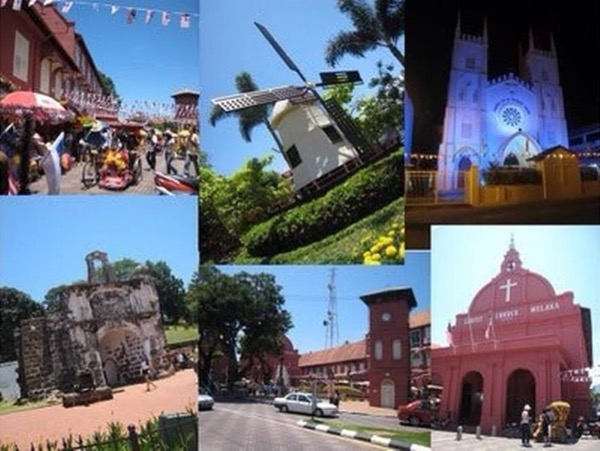
BANGKOK -- Arguably, no city in Asia is more evocative of the meeting of East and West than Malaysia's Melaka, also known as Malacca -- founding principality of the Malay peninsula, coveted and conquered by numerous European powers for its location on the strategic shipping lane of the Malacca Straits. But since 2008, when Melaka was designated a Unesco World Heritage site in a joint bid with George Town, in Penang state, the fragile outpost has succumbed to more modern foes: a surge in tourism from 7.5 million visitors annually to more than 12 million, a steep rise in property values and rents, and the construction of towering hotels, malls and new towns teeming with high-rises around its periphery.
"Before the inception of Unesco World Heritage, our town was rustic and unpretentious, full of unique flavors, hybrid races, the smell of incense, wood houses, the muddy river, the sounds of craftsmen at work," said Bert Tan, head of the local Malaysian History and Heritage Club, and a resident of Melaka. "But World Heritage status has changed Melaka from a quiet community to the monstrosity of tourist commercialism and business. Old traders have been replaced by fancy bars and hotels. We have cartoon heritage, monstrous mega-projects, Hello Kitty buildings."
Melissa Chan, curator of the historic Baba Nyonya House, noted: "The positive impact of World Heritage status has been an increase in visitors to Melaka. However, it seems to attract visitors who come primarily for the entertainment
value rather than the appreciation of a heritage town." Chan added, "There definitely isn't enough effective check-and-balance on new development projects. By the time the community knows about a pending development, it is too late and foundation work has already started.
The World Heritage program, launched in 1972 and run by the United Nations Educational, Scientific and Cultural Organization, was meant to safeguard the obviously great achievements of humanity -- "the 100 or so landmarks like the Pyramids [in Egypt]," explained Unesco program officer Montira Horayangura Unakul. But it has now expanded to include more than 1,000 sites around the globe. With hundreds more clamoring to win similar recognition (China and India have each proposed around 50 candidates), Montira acknowledged an ongoing debate within the U.N. about the program's reach.
Unesco officials argue that World Heritage status helps focus outside funding, attention and the aid of world-class specialists on preserving endangered cultural patrimony. But in 2008, a "process of reflection" about the future of the World Heritage Convention, an international agreement on the protection of natural and cultural heritage sites, was approved to facilitate discussion of issues such as geographic balance and a possible narrowing of the criteria for selection.
Help and protection
The program can boast many successes, such as designation this year of the first
World Heritage site in Myanmar -- the so-called Pyu Cities, abandoned ruins of the cradle of Burmese civilization, which desperately need renovation, study and
robust safeguards. There are also many other sites that are crying out for help and protection, such as Chandigarh, the capital of the Punjab, India, which was planned by the great architect Le Corbusier. While it awaits World Heritage designation, as part of a worldwide bid for many Le Corbusier works, Chandigarh's magnificent state buildings suffer from a poor state of maintenance.
However, even a casual survey of the World Heritage program's impact in Asia shows that it can be a double-edged sword. Nearly everywhere, the global branding that accompanies designation spurs a growth in tourism and investment, often leading to the cultural dilution or destruction of the communities it seeks to preserve.
In Melaka, "people have been driven out as the housing market has skyrocketed," said Ee Soon Wei, heir to the 19th-century Royal Press, a printing house that is now a museum and has become a major icon of restoration within Melaka's Old City. Residential market prices rose by 10% last year and the cost of terraced houses has increased by just over 50% since 2010. "There's no regulation of speculators, and the highest bidders win. There's no aesthetic, no feeling for the past," said Ee. "Where's the governance? Who is accountable?"
Lijiang, in China's Yunnan Province, was a tiny, traditional mountain hamlet, interlaced with clear waters flowing in stone canals -- until, marketed as the real "Shangri-La," it became flooded with 4 million Chinese tourists in the first year after receiving its World Heritage listing. Almost overnight, the canals were lined with restaurants and tacky souvenir shops.
The glittering temples and surrounding scenery of Luang Prabang, ancient capital of Laos, also saw a huge increase in tourism after it won World Heritage status in 1995. While temples and antiquities are well tended, the modern town has been made more uniform by a proliferation of hotels conforming to a "Unesco-approved" design.
Major monuments of the historic, British-built center of George Town, on Penang Island, are now protected. But here, too, longtime preservation advocates such as Clifford Liang, head of the Penang Heritage Trust, complain about the dominance of tourist priorities. Garish hotels have helped to fund the expensive restoration of traditional shop houses, but have also led to the gradual disappearance of inner-city residents and their traditional way of life. "Most of the older generation has vanished," said Liang. "It seems the only model of preservation is painting up old buildings until they are moneymakers."
Pierpaolo De Giosa, an Italian anthropologist who wrote a thesis on the inhabitants of Melaka's core World Heritage zone, noted, "While the UNESCO World Heritage program claims to empower local communities, the latter are not really empowered -- since the only way to nominate a site for World Heritage is through each nation-state." While countries make the case for selection, local authorities often end up charged with the task of supervising and maintaining the sites.
In Melaka, "the repeal of the Rent Control Act means many residents of the World Heritage area have left," said De Giosa. "And it does not make any sense to preserve buildings if the local inhabitants are displaced by processes of commercialization, gentrification and so on."
Mundane condominiums
Meanwhile, the small historic core of the city has become overwhelmed by surrounding modernization, proceeding seemingly without limits. "Heritage villages and the old Portuguese settlement, the habitats of coastal fishermen, are all being surrounded by new high-rises," said De Giosa. Mundane condominiums now line the once-atmospheric banks of the Melaka River.
Singapore's Hatten Group has become a major shaper of the city's landscape, with its Hatten Hotel and Square megamall covering more than 1 million sq. meters. A new project will add a 45-storey tower, two hotels, eight floors of retail space, a theater and a "Time Tunnel" featuring miniature replicas of Melaka's historic sites. In a statement, Hatten chief executive Colin Tan remarked, "In order to maintain our historical relics, we need to boost and sustain tourism."
Many of the issues arising from World Heritage status are beyond Unesco's legal reach. As a consultative entity, it cannot use the force of law to coerce local or national governments into abiding by certain practices. Its main leverage is to label sites as "in danger" or, in extreme cases, to remove the World Heritage designation. However, only two locations have been delisted in the history of the program, and both were natural refuges whose integrity as environmental sanctuaries had been undermined. Of the 48 sites currently listed as "in danger" of being seriously damaged or destroyed, the only entry in Asia is the Sumatran rainforest.
Along Melaka's historic Jonker Street, neon signs and billboards aimed at tourists provide a jarring contrast to the restored traditional shop houses on whose roofs they sit. Soon, the problems of over-development may worsen as direct flights to the city begin from Guangzhou, China, adding hordes of tourists on package tours to the existing visitor burden, much of which arrives from Singapore.
In an effort to fight back, Chan and Tan helped to mount an exhibition (New Old Malacca, Nov. 27-Dec 31, Daily Fix, 55 Jonker Street) at a local gallery, in Chan's view to "create awareness that the soul of Melaka is getting lost." Even when it comes to economics, she noted, "if a heritage city loses its unique identity, it becomes another generic 'me-too' and loses its value."
Chan and others can only continue to apply pressure on local authorities and developers to stop the relentless trend toward commercialization. Said De Giosa, "World Heritage status is for most Malaysians a source of pride. But I would say that it is a blessing but at the same time a curse."