Monday, August 19, 2013

CHANCE TO WIN DREAM HOLIDAY TO BALI FOR FOUR

19th. August 2013

Photographers are invited to unleash their creativity in a photographic contest for the chance to win a dream holiday to Bali, Indonesia.

Participants are require to capture the rich and unique heritage of Malacca.

The contest on August 24th. 2013 wich carries the theme Local Flavours is organised by the Avillion Hotel Group.

Contestants stand to win holidays at various destinations, spa package and a Canon camera.

The grand prize consists of a four-day, three night stay worth RM 7,050 at Villa Cinta, Sanur Beach in Bali for four people and a Canon EOS110D DSLR camera worth RM 1,699 to capture their gateway.

The other prize include free stays at the group's hotels in Idaman@Janda Baik in Pahang, Avillion Port Dickson water chalet in Negeri Sembilan, Avillion Admiral Cove executive studio in Negeri Sembilan and Avillion Legacy, Melaka.

To register, log on to www.facebook.com/avillionhotelgroup. Registration ends tomorrow.

Partipants have to pay a fee of RM 98 to enter the contest.

They will receive goodies such as a Canon Legria luggage strap, a photography talk by a Canon specialist worth RM 1,500 and lunch. By Kelly Koh, NST

ELECTRIC BUSES FOR MELAKA BEFORE CHINESE NEW YEAR 2014

Electric buses for Malacca

Posted on 18 August 2013 - 08:51pm Last updated on 18 August 2013 - 09:26pm Vathani Panirchellvum newsdesk@thesundaily.com

AYER KEROH (Aug 18, 2013): Malacca's plans of becoming a green technology city state steps closer with the advent of electric buses, scheduled to be launched before Chinese New Year next year.

Chief Minister Datuk Idris Haron said that for starters 10 buses will ply the World Heritage City of Bandar Hilir, giving a positive impact on the environment, according to a report in Melaka Hari Ini, a community newspaper.

"If this project is successful, Malacca will be the first state that uses electric buses as an initiative to improve the public transportation system in the state, making it comparable to other countries like the US and Japan. The use of the environmental-friendly electric buses will reduce the use of petrol and diesel, thus lowering the carbon footprint," he said.

Idris added that the project will give positive returns in the long run as the buses can fit up to 40 passengers and will reduce the usage of fuel as much as RM0.20 per km, bringing in a profit of RM0.49 per passenger to the government.

The buses can move up to 40km per hour, he said, adding that it is based on the town bus concept, with standing room for most, and seats prioritised for the elderly and people with disabilities.

Friday, August 16, 2013

BUKIT CHINA : A HILL STEEPED IN LEGEND AND HISTORY

Published: Friday August 16, 2013 MYT 12:00:00 AM Updated: Friday August 16, 2013 MYT 11:00:18 AM

Bukit China: A hill steeped in legend and history

BY M. VEERA PANDIYAN

VEERA@THESTAR.COM.MY

The Bukit China Chinese cemetery in Malacca is the oldest in the country.

Its name can be traced to a legendary Ming Dynasty princess who supposedly arrived from China to marry Mansur Shah, the sixth Sultan of Malacca who ruled Malacca from 1459 to 1477.

Bukit China (Chinese Hill) was originally an undulating jungle of three mounds — Bukit Tinggi, Bukit Gedong and Bukit Tempurong.

It apparently took on the name after the Sultan allowed the entourage of princess Hang Li Poh to settle around the foot of the main hill.

These days, there are doubts over the purported royal lineage of Hang Li Po, as there is no written evidence to show that she was indeed a princess.

The guesswork is that she might have been a daughter of one of the emperor’s concubines or even a royal handmaiden.

But there are no doubts about the special relationship between Malacca and China then.

According to the Ming Shi-lu (Veritable Records Of The Ming Dynasty), an envoy of Balimisura (Parameswara) went to China in 1405 to offer tribute and another arrived two years later, complaining about Siam’s aggression and seizure of his kingdom’s royal seal.

An example of past architecture at Bukit China. The following year, Ming’s renowned admiral Zheng He (Cheng Ho) was sent to Malacca.

Parameswara gave another tribute to the emperor the following year after Siam stopped intimidating his kingdom.

The records also note that Parameswara arrived at the emperor’s court on Aug 4, 1411 with his family of 540 followers and that he was treated with respect and showered with banquets and impressive presents during his stay.

As for Sultan Mansur Shah, the palace where he supposedly lived with all his wives, including Hang Li Po, was said to be at the foot of Bukit Melaka (today’s St Paul’s Hill).

There is now a replica of the palace, which houses the Malacca Cultural Museum. It was built using three types of hardwood — cengal, rasak and belian (for the roof) — based on what was written in Sejarah Melayu (Malay Annals).

It was written that the sultan ordered a well to be dug at Bukit China for the new immigrants. The well, Perigi Raja remains to this day and never dries up even during droughts.

Bukit China remained largely forested until the Portuguese built a chapel called Madre De Deus (Mother of God) and monastery at the top of the hill in 1581.

It was destroyed in an Achehnese attack in 1629. The Achehnese actually held Malacca for about eight months before the Portuguese won it back.

The monastery was rebuilt when the Achehnese were finally defeated with the deaths of prominent warriors, including Panglima Pidi whose grave, known as keramat panjang (long sacred grave) remains on Bukit China.

There are about 20 other Muslim graves nearby and the area used to be a favourite haunt of those seeking “spiritual help” for four-digit numbers during the 60s and early 70s.

In addition to the beach at Tanjung Kling, it was also an alternative site for the then popular Mandi Safar festival which was banned as “unIslamic” activities during the 80’s.

Bukit China became a Chinese cemetery in 1685 when Lee Wei King, the then “Kapitan China” of Malacca, bought the three hills from the Dutch and renamed them as “San Pao Shan” (Three Gems Hill or Three Protections Hill). He placed it under the trust of the Cheng Hoon Teng temple.

Reputedly the oldest remaining traditional Chinese burial ground in the world with 12,500 graves, Bukit China remained largely unknown and mostly overgrown until about this time of the year, 29 years ago.

All hell literally broke loose during the Hungry Ghosts Festival in 1984, when the Malacca Government announced its plans to develop the 42ha hill into a housing and commercial centre in July 1984.

The then Chief Minister, (now Tan Sri) Abdul Rahim Tamby Chik, gave three options — development of the hill solely by the Chinese community, joint development by the state and community or development by the state.

The plan sparked anger and outrage throughout the country, moving the diverse community to come together to preserve a heritage symbolising their earliest ancestors links to the country.

When the trustees of the Cheng Hoon Teng Temple conducted a survey to gauge public response on the development proposal, 553 associations and close to 300,000 people replied with a resounding no, against a mere 73 who agreed.

The country’s first Prime Minister, Tunku Abdul Rahman, was among those against the plan, lending more weight to calls for its preservation.

Representatives of political parties urged the then PM (now Tun) Dr Mahathir Mohamad to intervene and resolve the politically explosive and racially divisive issue.

As Carolyn Cartier, professor of geography and urban studies at the University of Technology, Sydney noted in her book, Globalising South China, the Save Bukit China campaign achieved ethnic and class representation and became a national movement, the first to grow to such proportions in the history of the country.

The State government eventually relented and has since been promoting Bukit China as part of its rich cultural heritage.

Today, the hill has become a recreational ground where joggers have carved out a track between graves. It has also become a valuable green lung for the city, offering great views from the peak.

The Chinese living around the area, covering Jalan Bukit China, Lorong Bukit China, Jalan Temenggong, Kampung Bukit China and nearby Banda Kaba, are referred to as the “San Pao Ching” community, in reference to several old wells in the area, seven of which were said to be dug during the time of Zheng He.

In addition to a hike up the hill, among the must-see sights for tourists are the Poh San Teng temple, built in 1795 by another Kapitan China, Chua Su Cheong and the Chinese War Memorial, located next to it.

The cenotaph to remember those who were brutally killed during the Japanese Occupation consists of an obelisk inscribed with Chinese calligraphy mounted on a raised platform with a Kuomintang flag at the top.

Thousands were killed after Malacca fell to the Japanese on Jan 15, 1942. The horror stories include burying victims alive and the killing of babies by throwing them up into the air and stabbing them with bayonets as they fell.
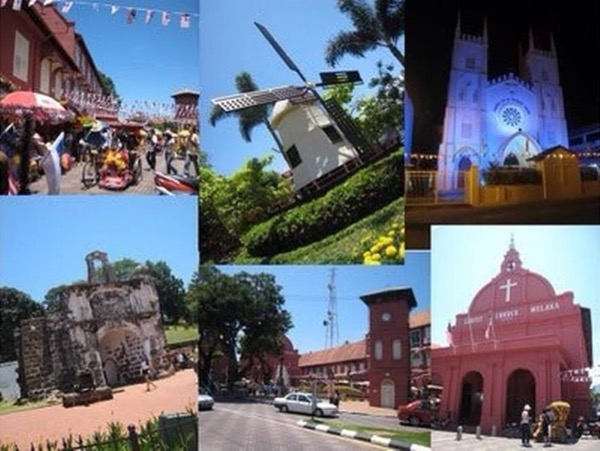
Tuesday, July 16, 2013

MELAKA TO HOST WORLD TOURISM CONFERENCE 2013

Malaysia/Melaka To Host World Tourism Conference 2013

PUTRAJAYA, July 15 (Bernama) -- The Ministry of Tourism and Culture together with the United Nations World Tourism Organisation and the state government of Melaka will organise the World Tourism Conference 2013 (WTC 2013).

The three-day conference will be held at the Equatorial Hotel, Melaka, from Oct 21, the ministry said in a statement today.

It said the main objective of the WTC 2013 is to discuss and address current and relevant issues related to the tourism industry, where the key areas for discussion would be on innovative marketing and directions for tourism product development.

Themed,"Global Tourism: Game Changer and Pace Setters", the conference is expected to bring together world leaders in tourism, high-level policymakers, specialists and experts from both the public and private sector to share experiences, while providing guidance for tourism development, the ministry said.

"Therefore, WTO 2013 should be attended by all travel and trade members in Malaysia, such as hoteliers, tourism officers, airlines and airport representatives, as well as tour operators among others, as they will get the opportunity to connect, share and learn during the event," it added.

It said registration for the conference is now open and the public can visit http://www.wtc2013malaysia.com for more details.

Tuesday, June 18, 2013

TOURISTS TO ENJOY FREE GUIDED TOURS IN MELAKA

18 June 2013| last updated at 11:55PM

Tourists to enjoy free guided tours in Malacca

By HANIS MAKETAB | news@nst.com.my

BOOSTING TOURISM: Money from Heritage Tax Fund will finance programme

MALACCA: THANKS to the state's Heritage Tax Fund, which now has RM2.9 million since it was introduced in April last year, tourists will enjoy free guided tours of Malacca's heritage trail.

Malacca Museum Corporation general manager Datuk Khamis Abas said the corporation would be organising the tours, which would be funded by the money collected from the heritage tax.

"The tours will take place every Tuesday, Thursday and Saturday.

"Forty thousand ringgit has been allocated for them, which is for a one-year period from this month. "It pays the allowances of our tour guides."

The tours would cover the state's famous and popular attractions within the World Heritage site, such as the Malacca River, Stadhuys, Porta de Santiago, the Malacca Sultanate Palace and the Proclamation of Independence Memorial.

He said the heritage tax was collected by local city and municipal councils, and went towards initiatives related to tourism and heritage, such as publishing a directory of places to stay in Malacca, organising courses under the Malacca Tourism Academy and contributing to the state's hotel and homestay operators associations.

"Last year, RM2.3 million was collected, while this year about RM657,000 has been collected up to May 15," Khamis said after giving state Heritage and Youth Committee deputy chairman Datuk Norpipah Abdol a tour of the Malacca Conservation Centre in Jalan Bunga Raya yesterday.

He said the centre, which began operating last Monday, was open to the public. It focused on the conservation of historical buildings and artefact.

Khamis also said the centre would be used as a venue for lectures, talks and workshops.

The centre is managed by the corporation with the cooperation of the state World Heritage Office, Malacca Historical City Council, Merlimau Polytechnic and Malacca Islamic University College.

- See more at: http://www.nst.com.my/nation/general/tourists-to-enjoy-free-guided-tours-in-malacca-1.302305?cache=%253Fpage%253D0%252F7.197525%3Fkey%3DKuala+Lumpur%3Fkey%3DKuala+Lumpur%3Fpage%3D0#sthash.KFq9q6DZ.dpuf

MELAKA TAMING SARI TOWER LURES 3.3 MILLION VISITORS WITHIN 5 YEARS

Melaka Taming Sari Tower Lures 3.3 Million Visitors Within Five Years

MELAKA, June 15 (Bernama) -- The Melaka Taming Sari Tower here has managed to lure 3.3 million visitors with ticket collection totalling RM29.9 million over the first five years of its operation.

Chief Minister Datuk Idris Haron said it was an increase of 0.8 million visitors from the original target set when it was first opened in April 2008.

Over the first five months this year alone, a total of 227,107 visitors with ticket collection of RM2.4 million were recorded, he said.

He said it was an overwhelming achievement, and hence proved the determination of the management of Melaka Taming Sari Berhad (MTSB) in turning the 110m tall tower worth RM24 million into Melaka's popular tourism product.

"We believe that this tourist product can contribute to the more developed and competitive eco-tourism industry," he said after opening the 5th anniversary celebration of the tower here today.

Also present were MTSB chairman Datuk Mat Sirat Abu and chief executive officer Mazary Ahmad.

Idris said MTSB would also introduce a new tourism product soon, that is a 'reverse bungee', in a bid to diversify the tourism products at the tower.

However, he said the reverse bungee facility, which is expected to be built at the end of this year, must get prior approval from the United Nations Educational, Scientific and Cultural Organization (Unesco) as it would be built on one of the world's heritage site.

"It is still at the discussion stage and we will seek advice and consultancy from the supplier and Unesco about the suitability of the location and height," he said.

At the event, Idris also launched the book published by MTSB titled 'Heritage Trail Melaka Mosques', which showcases the beauty of mosque architecture in Melaka, including at the Selat Mosque, Tengkera Mosque and Al-Azim Mosque.

-- BERNAMA

Thursday, June 13, 2013

MELAKA RIVER PROJECT NOW A MODEL FOR OTHERS

14 June 2013| last updated at 11:38PM

Sungai Melaka project a model for others

By Jason Gerald | nstjason@gmail.com

REHABILITATION: The once lifeless waterway has been turned into Malacca’s most lucrative tourism product

THE phrase "Everything began in Malacca" is not something which was just coined to attract tourism, but is in actual fact what this state has to offer to other states in Malaysia.

The birth of the nation is attributed to the glory of the Malacca sultanate in the 15th century, and Malacca is where the independence of Malaysia was first announced by the country's founding father, Tunku Abdul Rahman Putra Al Haj at the Dataran Pahlawan in Banda Hilir.

Malacca has been a benchmark for many developments in the country after the state was steered into becoming a developed state -- recognised by the Organisation for Economic Cooperation and Development (OECD) -- and is now spearheading the nation's green technology initiatives.

And now, what was once famed as one of the busiest ports in the world, the Melaka River, is becoming a benchmark for the rehabilitation and beautification of rivers throughout the country.

Known as the Venice of the East in the 15th century, the waterway had slowly deteriorated and became one of the dirtiest rivers in the country till some 12 years ago.

In 2001, the state government, with assistance from the Federal Government, had embarked on the first phase of the Melaka River beautification project costing some RM200 million.

The first phase of the Melaka River rehabilitation project started at the tip of the river mouth to the Hang Tuah bridge which included the construction of two new jetties and an archway across the river.

The restoration and beautification project paid off handsomely, as now the once lifeless river has not only been revived but it has been turned into the most lucrative tourism product that Malacca has to offer.

The recent Sungai Melaka International River Festival created history when the Drainage and Irrigation Department director-general, Datuk Ahmad Husaini Sulaiman, said the State administration's success in turning the river into one of the finest in the country, region and also the world would be the main point of reference for the revival and beautification of all rivers in the country.

The effort taken by the Malacca government in beautifying the Melaka River has not only managed to turn the river into a commodity for tourism but also helped in mitigating floods.

Under the 10th Malaysia Plan all rivers in the country were allocated RM3.47 billion for flood mitigation works, rehabilitation and beautification exercise. Melaka alone was allocated RM285 million.

In Malacca's case, this money was not only used for flood mitigation works but also for the cleaning, beautification, and upgrading of the river system from the Sungai Melaka estuary right up to Malim.

This success of making Sungai Melaka into a living river is proposed to be replicated across the country.

Sungai Melaka is flanked by several delightful structures such as the Dutch or Red Square, traditional villages and other tourist attractions. In the second phase of its rehabilitation would start at the Hang Jebat bridge up to Batu Hampar, covering 5.2km.

The second phase would be divided into three main work packages; first would cover a 2.4km waterway from the Hang Jebat bridge to the Tun Razak bridge, followed by 1.2km from the Tun Razak bridge to the Melaka Sentral bridge, and the final package from the Melaka Sentral bridge to the Tidal Control Gate that stretches for 1.6km.

This would also include deepening the depth of the river, constructing walls and walkways along the river, landscapes, three water taxi stations at Taman Rempah and Jusco AEON, building unique bridges and beautifying the banks of the river.

Once the project is completed, the water quality of Sungai Melaka is expected to improve from class 111 barometer to class 11B by the year 2015.

The current success of the Melaka River rehabilitation and beautification project could also be seen through the Melaka River Cruise.

When the cruise started in 2006 there were only 56 visitors, but last year alone it attracted some 1.1 million passengers, and this year it is targeted that the Melaka River Cruise would attract some 1.4 million visitors.

Besides being a benchmark for rivers in Malaysia, the Malacca government is also aiming to work towards getting this event listed on the World Tourism Calendar of Events, similar to the San Antonio River festival in Texas, United States.

Read more: Sungai Melaka project a model for others - Columnist - New Straits Times http://www.nst.com.my/opinion/columnist/sungai-melaka-project-a-model-for-others-1.299900#ixzz2WE8IVouO