Sunday November 27, 2011
500 years on
By N. RAMA LOHAN
star2@thestar.com.my
Yes, we all know the Portuguese came and conquered Malacca in 1511 — but did you know that they tried to take the Sultan’s magnificent bed back to Portugal?
IN the port town of Belem, near Lisbon, a map of the ancient world etched on the ground near the Padrão dos Descobrimentos (Monument to the Discoveries) has Malacca carefully noted on it. Or “Malaca”, as it’s spelt there. It’s only fitting that this European town on the other side of the world marks our little city/state because it was from Belem that seafaring Portuguese in the 15th and 16th century set off to explore and trade with India and the Orient during the Age Of Discovery – and Malacca’s role during that age was very much more than just a footnote in both Portugal and Malaysia’s history
This year marks the quincentenary of the capture of the famously-rich and thriving port back in 1511 by the second Viceroy of India, Admiral Alfonso de Albuquerque. Of course, anyone who has ever gone through the Malaysian school system will know that date, and the events and consequences of the time the “white man” came to these shores. But behind the sweeping events on history’s stage are intriguing nuggets known mostly to historians or students of history alone. For instance, according to the Portuguese, Sultan Mahmud Shah, the then ruling Sultan of Malacca, was an opium addict! Though the The Malay Annals (Sejarah Melayu) does state that he was also fond of literature and studied religion....
Malacca in the world: In the Mappa Mundi (World Map) etched into the ground in Belem, ‘Malaca’ is about the only location noted for this part of the world (close up, below, right), a sign of the city-state’s influence in the 16th century.
Rocking the status quo
Two years before the landmark events of 1511, though, Portugal and Malacca were already in conflict when Admiral Diego Lopez de Sequeira arrived at the trade-rich entrepot at the behest of Portugal’s king, Emmanuel I, to establish trading ties.
The Portuguese themselves had only then recently rid themselves of Moorish domination within the Iberian Peninsula, a liberation after 800 years. Almost as a backlash, the need to spread their Christian faith grew exponentially, and coupled with the desire to extend its trade dominance, the Portuguese eventually became the first global empire and the longest lasting of the European colonial empires, spanning nearly 600 years.
“Before the Portuguese found their way to India and further to the Far East, the Muslim Moors controlled the spice trade to Europe. Wresting this control was seen as a commercial gain as well as a religious duty – an extension of the crusades the Christians had long waged against the Muslims,” reveals historian Dr Khasnor Johan, who taught history at Universiti Kebangsaan Malaysia from 1974-1992 and has the book The Emergence Of The Modern Malay Administrative Elite to her name.
Christianity and the Europeans’ trade request were entertained with little courtesy and the reigning Sultan of the time, Sultan Mahmud Shah, egged on by Gujerati Muslim traders who were hard-done-by the Portuguese previously, chose to attack the very first Portuguese fleet to arrive in Malacca.
“The presence of the Portuguese would have been seen as additional competition and a threat to the status quo, so it is not unexpected that they (the Gujerati Muslim traders) would have been unhappy.
“The Muslims would have used religion as an additional factor in making the argument that the Portuguese should not be welcomed, thus persuading the Sultan not to conclude a treaty of peace with the Portuguese,” Khasnor explains.
“It has to be remembered that under the Malacca Sultanate, a system of trade and community relations had already evolved and worked well. The arrival of the Portuguese injected a new element into that system, upsetting the balance in the process,” Khasnor says.
That altercation would condemn Malacca to impending doom and the day arrived when Albuquerque – along with a thousand-odd men, comprising 800 Portuguese soldiers and 300-600 Malabarian mercenaries – sailed into the port town in July, 1511.
The pretext of the visit was to retrieve the Portuguese men held captive from two years before, but Albuquerque was also determined to wrest control of the renowned spice and China trade, in which Malacca played a crucial role.
Following a fierce battle that raged for three weeks, the Portuguese gained control of Malacca and would reap the benefits of the land and the city’s strategic location, controlling access to the Malacca Strait, a vital part of the trade route between East and West until the Dutch arrived to do the same in 1641. The superiority of the Portuguese proved too much for the men of Malacca to defend their port.
The Sultan’s men and mercenaries were reported to have used arrows, blow pipes with poisoned darts, the kris, lances and even guns. Allegedly, cannon were even discovered, some of which were dislodged from the ships of the Gujeratis and used on land.
Following the aftermath of the battle, the Portuguese retrieved 3,000 pieces of artillery and among them were 2,000 in bronze and one very large gun that the Samorin of Calicut (the ruler of a kingdom in South-West India) had sent to the Sultan of Malacca.
The small calibre guns are said to have been made locally, which is truly illuminating of the weapons technology available to Malacca then.
According to Peter Borschberg, an associate professor in the Department of History at the National University of Singapore, it was the Portuguese fire power that allowed them to defeat the defenders of Malacca easily. “Armour, tactics, military training, discipline of the troops would have all contributed,” he says.
Khasnor concurs: “The small arms of the Malays were no match for the Portuguese cannon, whose range was much further. The Portuguese strategy of attacking the bridge, thereby splitting the Malay forces into two, also played a big role in their victory.”
Albuquerque and his men chose to attack the bridge crossing the river that runs through Malacca town, knowing full well that would effectively divide the administrative part of the town from its commercial centre.
Alfonso de Albuquerque’s stature and impressively long beard reportedly had the Malaccan delegation bowing in awe and reverence when they caught their first glimpse of him on board his ship. — Image from Lendas da India, courtesy of Peter Borschberg
Carving up the region
The story of the fall of Malacca is one that is perhaps not necessarily the most unique. Also, it isn’t in the least bit aided by the history books in school painting a vague account of the events of 1511.
While the prescribed school syllabus for secondary schools by the Ministry Of Education mentions the likes of Albuquerque and of course, Sultan Mahmud, it leaves out colourful characters such as Utimutiraja (the rich and powerful Javanese trader living in Malacca who double-crossed both Sultan Mahmud and the Portuguese!), Nina Chatu (the influential Malaccan Hindu trader who aligned himself with the Portuguese) and Rui de Araujo (one of the captives in Malacca who – in a tale that could have come straight out of a modern thriller – relayed intelligence to Albuquerque with help from Nina Chatu between 1509 and 1511).
Whatever weight the school books give to the events of 1511, they were without a doubt among some of the most significant in Malaysia and Malacca’s history, arguably on par with America’s war of independence with the British in 18th century.
But unlike that conflict, which had a positive impact, giving Americans nationhood and setting them on course to world domination, the arrival of the Portuguese in Malacca, on the other hand, put a halt to the potential expansion of the Malay archipelago’s nascent power.
Things took a turn for the worse when rivalry among European powers further led to the carving up of many Asian regions into different spheres of influence.
Malacca’s fame during the 15th and 16th century as a lucrative entrepot in the region was actually unfortunate, as it made the port a target that the Western powers desired to control.
Malacca’s occupation isn’t merely about statistics or interesting stories confined to the history books because we continue to live with some of the consequences today.
“In view of the emergence of the nation states in Europe and the expansion of naval power and shipping, which allowed expeditionary voyages and long distance trade, it seems almost inevitable that Asia would have eventually been exposed to Western domination,” theorises Khasnor.
The control of the Malay archipelago might have begun at the periphery with the Portuguese and the Dutch, but by the time the British arrived, the Western world was taking much more of a hand in events in this part of the world.
“We are therefore still living with the consequences of that domination. For a very long time, our right to determine our own destiny and direction was taken away from us. But on the other hand, it is hard to see how we might have evolved or developed had we not been under Western domination,” adds Khasnor.
Thailand is a prime example. It was never colonised, yet it has developed, economically and politically, in much the same way Malaysia has, even if details differ.
The Portuguese believed Malacca’s position was so strategic that they constructed A Famosa in the port town to protect the trade route between Asia and their homeland. — File photo
Legacies left behind
The colonisation of Malacca may have very well kicked off the start of globalisation in this part of the world, a point observed by Borschberg, too.
“I was recently (in June) at a conference in Frankfurt (Germany) where issues of globalisation were discussed in connection with the Middle Ages. It was fascinating because the discussion traced the transmission of foodstuffs from Asia to Europe in the 6th to 14th centuries.
“But I suppose what made the case of the Portuguese different was the direct contact (not just gradual transmission, as in the Middle Ages) and the shift from overland to seaborne or maritime trade.
“Seaborne trade in the so-called Age Of Discovery enabled more goods to be exchanged and a greater number of people to interact. The real discoveries are not so much the lands of Asia or the Americas, but rather, the sailing techniques and the navigational routes to get to these places.”
The Portuguese capture of Malacca can be viewed as the case of an Asian port that was plundered by all-conquering colonists who exerted their might in the name of commerce and religion. However, the state today isn’t bitter about its past, claims Khasnor.
“The Malays are still proud of the fact that Malacca was once well known as a sultanate and one of the most important centres of trade and commerce in the East. Today, Malays might feel a sense of regret that Malacca was captured by the Portuguese and was never restored to the Malays until the end of British colonial rule, yet, when Malacca, as a state, celebrates its past history and heritage, it includes among the highlights of its existence the Portuguese influence, the unique blending of the races in the Portuguese Eurasian groups, the Baba-Nyonya and Indian Muslim communities and their cultural contributions,” Khasnor shares.
Historians speak of language and linguistic legacies left behind, and with the language came new ideas and concepts, Roman Catholicism, the introduction of foodstuffs and cooking styles, clothing items, architecture and building styles (the A Famosa Fort, among others).
“But influences are rarely a one-way process. More often than not, in the long run, you give and adopt into your own culture. And then there is the fusion of cultural practices – hybridity,” Borschberg adds.
Although the Dutch were also in Malacca, they stayed clear of making changes when they realised how well-assimilated Portuguese culture was, which is why the presence of the Portuguese remains strong in Malacca to this day, even half a millennium later.
In 1641, when the Dutch took hold of Malacca, the Portuguese were allowed to leave – as amnesty in the name of Christianity – but they weren’t allowed to take their slaves with them. So the backbone of the Portuguese community in Malacca was formed by Portuguese-speaking slaves and the few Portuguese who stayed behind, those who married locals and adapted to the way of life here.
“The Portuguese were in control of Malacca for more than a century and in that period, there would have been a small number of Portuguese who stayed long enough to form a community of their own. There would have been no women among them and for that reason, some would have married local women,” Khasnor explains.
Borschberg reckons that the number of Portuguese who stayed back would have been very small. “According to period documents of the time, 52 casados (a married settler) and their families ... all in all, fewer than 300 souls,” he says.
(According to census figures provided by Malaysia’s Department of Statistics, as of 2000, Eurasians in Malaysia – citizens and non-citizens – number 14,108. In Malacca alone, there are 2,176. The latest figures, from the 2010 census, are not available, as they are still being compiled.)
The Portuguese only had around 600 men in Malacca at any given time during their 130-year reign, and because their strength was in naval activity, they never sought landlocked regions, which is why they stuck with only Malacca and didn’t venture beyond to the rest of the Malay Peninsula.
“The Portuguese in Asia generally didn’t want large chunks of land to look after. It’s also a question of having sufficient manpower to control their possessions, and manpower was always short,” says Borschberg.
Of course, one of the greatest gifts of the Portuguese coming to Malacca are the stories left behind, especially the legends, and perhaps the greatest legends among them all is that of the Flor de la Mar (Flower Of The Sea) and her cargo.
The Flor was the largest carrack (three- or four-masted merchant ships) in its time and was used extensively in the Portuguese conquests of Asia. Close to a year after being in Malacca, when Albuquerque finally decided to sail back to Goa, India, he and his men loaded the Flor with the rich spoils of the Malacca sultanate, including jewellery, ornaments, statues and even the sultan’s bed.
Sailing north to the northern tip of Sumatra, the Flor encountered bad weather and was wrecked on some shoals. The ship split in half and lost all of its treasures, which according to treasure hunters, is the most valued shipwreck in the world. Albuquerque himself nearly perished in the disaster but was rescued.
Portuguese domination of Malacca lasted from 1511 to 1641, but though those events go back hundreds of years today, they have been woven into the very fabric of Malaysian society. In general, many of us treat those events as history book material, but think about it, in a strange way, the Portuguese put Malaysia on the world map all those years ago – they brought the Western world to us and made our presence known to the Western world.
All the countries around Malaysia were colonies of Western powers, except Thailand, so becoming a vassal might have been the only way for us to eventually become a modern civilisation. The accuracy of that opinion is open to debate, but we’ll just never know, will we? If you have an opinion – or an alternate history for Malaysia even! – share it with us at star2@thestar.com.my.
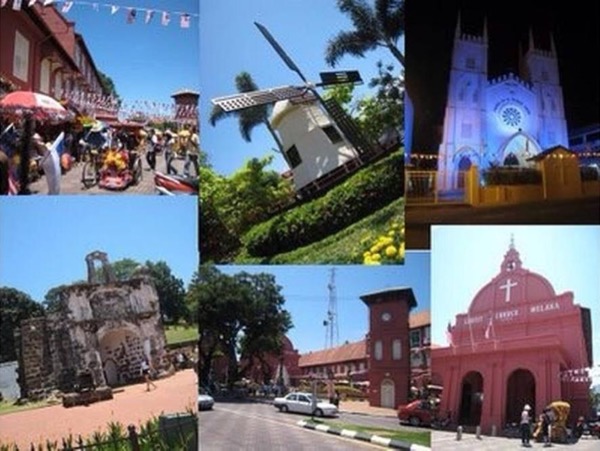
MELAKA - UNESCO World Heritage City since 2008. GPS: 2°11'58"N 102°15'02"E
Monday, November 28, 2011

Sunday, November 27, 2011
MONORAIL BACK IN OPERATION
Sunday November 27, 2011
Malacca monorail up and running again
MALACCA: The Malacca river monorail service is back on track.
The service, which was suspended after a breakdown on Sept 30, was given the go-ahead by Land Public Transport Com mission (SPAD) to resume operations starting Thursday.
The monorail service, which has suffered numerous technical glitches since last year, now has better safety measures.
A ‘rail’ relief: People boarding the monorail after SPAD gave the green light to the operator to resume its service in Malacca.
SPAD chief operating officer Azhar Ahmad said the commission was satisfied that monorail operator Menara Taming Sari Sdn Bhd had fulfilled all safety and security requirements.
“During our engineers’ inspection on Nov 23, all safety and security measures were in place,” he said.
Azhar added that the China-made monorail line was now equipped with a cherry picker – a hydraulic crane to rescue stranded passengers, should the coach stall.
“Passengers need not come down using a ladder any more,” Azhar said.
The monorail’s operation and service manual, previously in Chinese, had also been translated into Malay and English, he added.
On the monorail’s tyre traction which was said to be weak when it rains, he said a thermal paint was required to provide better traction during slippery conditions.
Azhar said the operator had set a date for this to be done.
Menara Taming Sari chief executive officer Nazary Ahmad said work to apply the thermal paint would be carried out in early January.
“Until then, we will follow SPAD’s instruction to only operate the monorail when there is no rain,” he said.
Nazary said the lifting of the suspension was good news for Malacca’s tourism industry, especially as the year-end school holidays had started.
The RM15.9mil monorail line had experienced 21 service disruptions since starting operations on Oct 20 last year until the suspension on Sept 30. The company suffered losses of more than RM74,180.
The monorail line spans 1.6km from Taman Rempah in Pengkalan Rama to Kampung Bunga Raya Pantai, along the scenic Malacca river.
MELAKA-SARAWAK DIRECT FLIGHTS
Kuching-Melaka direct flight early next year
by Simon Ingka Crown, reporters@theborneopost.com. Posted on November 26, 2011, Saturday
KUCHING: A direct flight connecting Kuching and Melaka may commence as early as next month or early next year.
Melaka Chief Minister Dato Sri Mohd Ali Rustam when announcing this yesterday said he was keen to see the flight become a reality, possibly three times a week.
“I am looking forward to see the Sarawak and Melaka state governments collaborate on the direct flight to Melaka in the best interest of both states,” he told a press conference.
Mohd Ali is in the state with the Melaka Foundation (YM) delegation and its board of directors to witness a Memorandum of Understanding (MoU) signed between Sarawak Land Custody and Development Authority (LCDA/Pelita Holdings Sdn Bhd) and YM yesterday.
LCDA was represented by Senior Minister and Land Development Minister Tan Sri James Masing and two Assistant Ministers, Datuk Gramong Juna and Datuk Abdul Wahab Aziz.
Also present was Senior Minister Dato Sri Wong Soon Koh who is also mnister of local government and community development, and second finance minister.
Mohd Ali said the route could boost tourism in both states.
“Melaka so far receives a total of 10.4 million tourists in 2010 with 20 per cent of them from overseas: Taiwan, Japan,China, Hong Kong, German, Switzerland and New Zealand.”
He said as of September this year, a total of 8.4 million tourists had visited the historical city, and the number is expected to reach 11 million by yearend. He said the proposed Kuching-Melaka flight could be shortened to one hour, compared to the one-and-a-half hour Kuching-Kuala Lumpur route.
“The flight is shorter than that to Kuala Lumpur International Airport (KLIA). Hence this could be an alternative route.”
At the moment, Melaka is chartering Firefly and Melaka Air flights to Pekan Baru and Medan City on the island of Sumatera in Indonesia. The flight connection had lured many tourists from the neighbouring country to the city.
“Sumatera is a big island and at least 10 per cent of the population are from high income families who choose Melaka as a holiday destination every year,” he said.
Mohd Ali said the Melaka state government was planning to construct a larger theme park to lure tourists.
“We are launching a wildlife park this afternoon (yesterday) and Hang Tuah Village theme park which portrays the era of the Melaka Sultanate.”
The state government would build the largest silat arena next to Hang Tuah theme park. Mohd Ali said the Melaka government would continue to cooperate with the Sarawak government to promote their tourism to the world, especially eco-tourism.
“Sarawak has a lot to offer the world – fantastic natural scenery and many others including the famous Rainforest World Music Festival. Mohd Ali said this was the first time the two governments were working together. I hope this will not be the last but open the way to many more joint ventures between the two states.”
Wednesday, November 23, 2011
MELAKA BEACH FESTIVAL 2011
24 November 2011 | Last updated at 01:17AM
100,000 expected at Tanjung Bidara's beach festival
By Jason Gerald John | 0 comments
MALACCA: Some 100,000 people, both locals and tourists, are expected at the Melaka Beach Festival 2011, which would be held at the Tanjung Bidara beach from Dec 9 to 11.
tanjung bidara
The scenic Tanjung Bidara beach will host modern water-sport activities and also traditional games next month.
The festival's organising committee chairman, Datuk Abdul Karim Sulaiman, who is also the Tanjung Bidara assemblyman, said the event would involve both modern water-sport activities and also traditional games.
Among the activities which would be held during the three-day beach festival are sailing competitions, pillow fights, climbing the slippery pole, tug-of-war, beach volleyball and soccer, duck catching competition and mountain bike racing.
"Besides these activities, we would also be organising a beach run, fishing competition, kite flying competition, karaoke competition and also the Big Bike Charity Wash," he said recently.
Karim said the event, which is organised by the State Tourism Promotion Board and the Alor Gajah Municipal Council, would also see a career opportunity and exhibition by the Armed Forces.
"Pos Malaysia Bhd will host a photography exhibition and a sepak takraw competition at the event.
"This event would be a huge hit among visitors to the state as it is one of the year-end programmes which had been included in the 2011 Melaka Tourism Calendar.
"I hope people from all walks of life from in and out of the country would join us for the three days of fun, games and family outing, especially during the school holidays.
"I am sure there would be something for all family members and visitors to participate in and it would surely be a memorable experience," he said.
Read more: 100,000 expected at Tanjung Bidara's beach festival - Central - New Straits Times http://www.nst.com.my/streets/central/100-000-expected-at-tanjung-bidara-s-beach-festival-1.10102#ixzz1eaajkhmv
Thursday, November 17, 2011
MELAKA TRAM ON TRACK
Email Print 17 November 2011 | last updated at 01:06am
Tram project on track
0 comments
MALACCA The proposed RM272 million Melaka Tram project linking Ayer Keroh and Banda Hilir is the most effective mode of transportation to overcome the traffic woes here, Chief Minister Datuk Seri Mohd Ali Rustam said yesterday.
"We have already obtained the green light from the Land Public Transport Commission (SPAD) for the project.
"In October, the state had written to the Federal Government, through Prime Minister Datuk Seri Najib Razak, for approval," he said.
"We are now awaiting the approval from the prime minister.
"Once it is obtained, we will exhibit the letter together with complete details of the project.
"This is to show the public that the project would bring great benefit to them."
The Melaka Tram project is a joint venture between Mrails International Sdn Bhd and Chief Minister Incorporated (CMI).
The service would have 23 stops along a 40km-route from Ayer Keroh to Banda Hilir, the heart of the historical city.
It is estimated that 250,000 passengers would use the trams monthly.
Annual revenue would be in the region of RM20 million.
The tram would go through Bukit Baru, Peringgit, Jalan Munsyi Abdullah, Bandar Hilir and Taman Melaka Raya.
Ali Rustam was speaking to reporters when he was asked to comment on the unsuccessful bid by Betty Chew Gek Cheng (DAP-Kota Laksamana) to have the Melaka Tram project shelved through a motion she had tabled at the Malacca State Legislative Assembly.
The motion was rejected by the house.
Ali Rustam said the Traffic Impact Assessment (TIA) and the Environmental Impact Assessment (EIA) on the Melaka Tram had also been completed and the necessary approvals had been given.
"Studies have also shown that the Melaka Tram would be used by 109,559 people from Monday to Friday.
"The figure is expected to soar to 210,160 during the weekends," he said.
Wednesday, November 16, 2011
PORTUGUESE CELEBRATING 500 YEARS IN MELAKA
17 November 2011 | Last updated at 09:08AM
Marking the date the Portuguese came a-calling
By ADRIAN DAVID AND JASON GERALD JOHN
MALACCA
streets@nstp.com.my
Portuguese culture was splendidly displayed over four days of pomp and gaiety to commemorate the 500th year of the arrival of the former European naval power in Malacca.
The Trez Amigos comprising Emile Mossinac (left), Horace Santa Maria (with walking stick) and brother Arthurs Santa Maria(right) after receiving their merit award from MPEA president Michael Singho (in suit).
Portuguese
The Portuguese Settlement in Ujong Pasir in the former Straits Settlement saw a hive of activity with cultural activities, music, dances, and dining during the celebrations last month.
Malacca Chief Minister Datuk Seri Mohamed Ali Rustam launched the event on Oct 28, with the official dinner and dance held the following day.
The latter event was attended by state police chief Senior Assistant Commissioner Datuk Chua Ghee Lye and Malacca Portuguese Eurasian Association president Michael Singho, who was the event organising chairman.
Performances were given by local groups, as well as those from Portugal, Timor-Leste, Selangor and Federal Territory Eurasian Association, Penang Eurasian Association, Australia Eurasian Association of Western Australia, Sarawak Eurasian Association, Kedah Eurasian Association, Perak Eurasian Association and the Eurasian Association of Singapore.
People of Portuguese descent from Lisbon, Australia, India, East Timor, Indonesia and Singapore joined their Malaysian counterparts to mark the anniversary of Alfonso d'Albuquerque's arrival to Malacca on Aug 24, 1511. The Portuguese navigator came from Goa, India, with 18 ships and 1,200 men.
The celebration, themed Our Roots... Our Heritage... Our Home, attracted tourists and foreign media. They tasted traditional dishes such as belacan (shrimp paste), cincalok (fermented shrimps), acar (pickles) and debel curry. They also got acquainted with cultural activities such as dances and songs.
The event also saw an exhibition of contemporary items.
There were cooking demonstrations by famous local chefs, handicraft demos by cottage industries, and local fishermen pitting their offshore skills such as the sewing and repairing of nets. Fairs which sold souvenirs, costumes and handicrafts, and indoor and outdoor games were added attractions.
There were songs and music aplenty from a legion of musicians. Not to be missed were the branyo folk dance and cultural performances that made the celebrations a truly Portuguese affair. The event is a reflection of how the settlement has become the bastion of Portuguese-Eurasian heritage and culture.
Most of the hymns at the mass at the settlement's chapel were sung in Cristang, the local Portuguese dialect.
The celebrations ended with a float parade of replicas of the 16th-century Portuguese ship, Flor de la Mar (Flower of the Sea), the fort A' Famosa (The Famous), fishing boats, costume-clad revellers, musicians and cultural group performances.
It was in 1641 that the Dutch conquered the Portuguese to take control of Malacca.
Read more: Marking the date the Portuguese came a-calling - Central - New Straits Times http://www.nst.com.my/streets/central/marking-the-date-the-portuguese-came-a-calling-1.6877#ixzz1dwYmjiTO
SUBMARINE MUSEUM TO DRAW TOURISTS
November 13, 2011 16:01 PM
Submarine Museum To Draw More Tourists To Melaka
MELAKA, Nov 13 (Bernama) -- A decommissioned Royal Malaysian Navy submarine converted into a museum submarine will be opened for public tours for 10 days from Nov 22 at the 1Malaysia Square, Klebang here.
Melaka Chief Minister Datuk Seri Mohd Ali Rustam said the submarine berthed yesterday and would be raised from the dock on Wednesday and transported to the exhibition site through a makeshift jetty three days later.
He said the French made SMD Ouessant (Agosta 70 class) submarine, which was built in 1979, had been handed over to the state government.
The submarine museum project costing RM12.6 million is expected to draw more tourists to Melaka, he told reporters during a site visit here today.
Tickets for the exhibition are priced at RM3 for adults and RM1 for children while senior citizens will get a 50 per cent discount, he told reporters at the Submarine Museum here today.
The Agosta submarine was used for the training of the first Malaysian submarines crews from 2005 to 2009 following a contract signed by Malaysia for the acquisition of two French Scorpene submarines in 2002.
The submarine was transported on a floating dock back to Malaysia on the first week of October and handed over to the Melaka government.
-- BERNAMA
Subscribe to:
Posts (Atom)